Landmarks in Tbilisi
A fortress ridge, riverside cathedrals and a Moorish-revival theatre share one skyline.
Tbilisi's landmarks cluster along the Kura River gorge and the ridge above it. A walled fortress caps the hill over the old town, while two Georgian Orthodox churches face each other from cliffs on opposite banks, rebuilt repeatedly in stone and brick after centuries of invasion. Further out, a nineteenth-century avenue laid down under Russian rule carries an opera house dressed in horseshoe arches and striped Oriental-revival brickwork, its European hall hidden behind that exterior. The result is a compact stack of periods rather than a single style: early medieval church-building, a defensive stronghold, and imperial-era institutions built to make a provincial capital look metropolitan.
Narikala
400
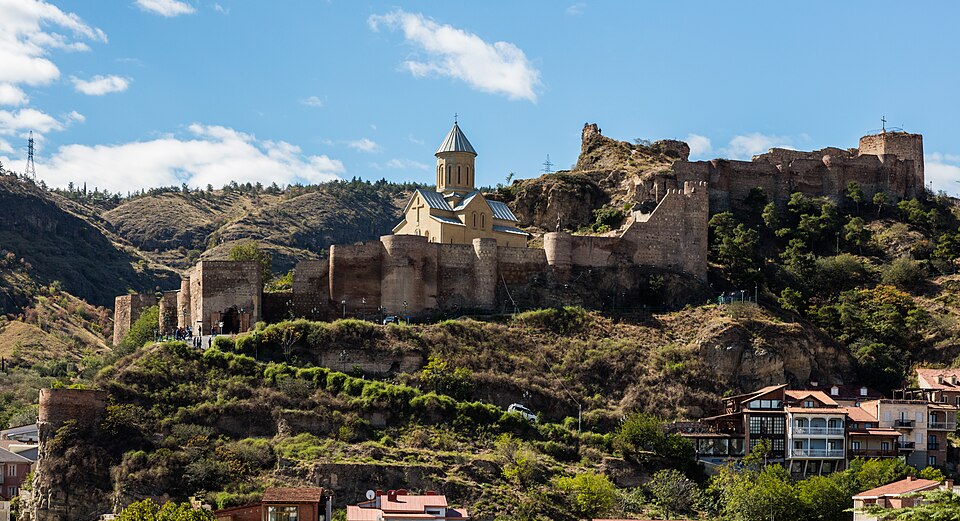
Crenellated stone walls climb a bare, steep hillside in two linked sections, following the ridge line above the river; a small white church sits within the lower enclosure, and the old town's tiled roofs spread below.
A defensive stronghold on a steep hill above the river, built in two walled sections between the sulfur baths and the botanical garden below. Its lower court holds St Nicholas church, a 1996–1997 rebuild that replaces a thirteenth-century original destroyed by fire. The new church follows a prescribed-cross plan with doors on three sides, its interior frescoed with biblical scenes alongside episodes from Georgian history.
- The church inside the walls looks medieval but was entirely rebuilt in 1996–1997, replacing a thirteenth-century predecessor lost to fire.
- Its frescoes mix biblical scenes with episodes from Georgian history rather than religious imagery alone.
Photo: Diego Delso (CC BY-SA 4.0)
Metekhi Church
1278–1289
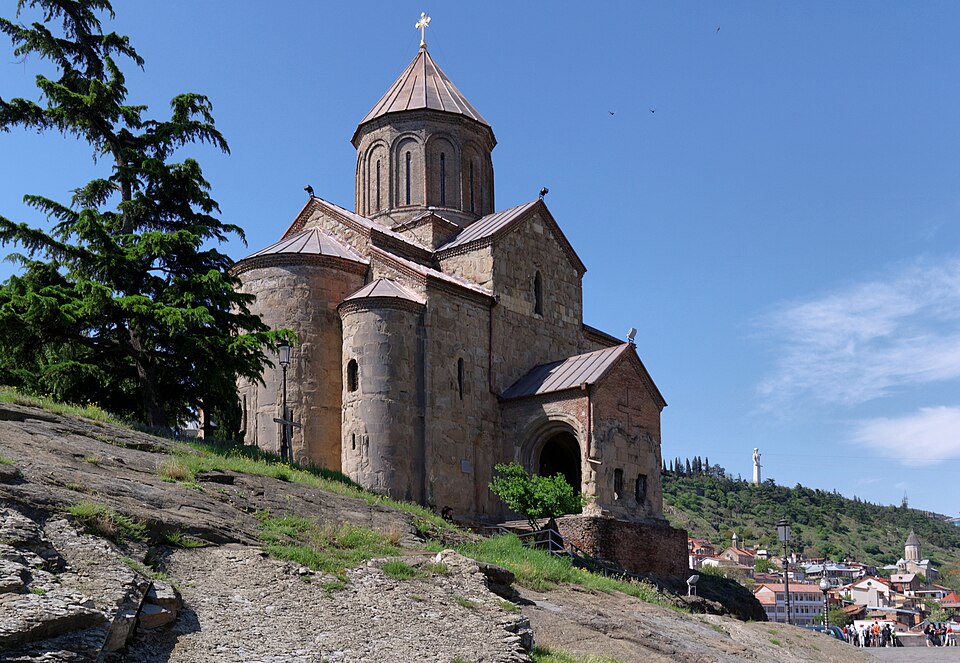
A compact stone church with a conical-domed drum stands right at the edge of a cliff over the river, facing the old town's rooftops across the water.
A Georgian Orthodox church set on a cliff above the river, facing the old town across the water. Most of the structure standing today was built between 1278 and 1289 under King Demetrius II, though oral tradition places the site's origins as far back as the fifth century. It remains one of the city's principal riverside churches and a fixture of the view over the old quarter.
- Oral tradition traces the site back to the fifth century, nearly eight hundred years before the standing church was actually built.
Photo: Alexxx1979 (CC BY-SA 4.0)
Sioni Cathedral
13th century
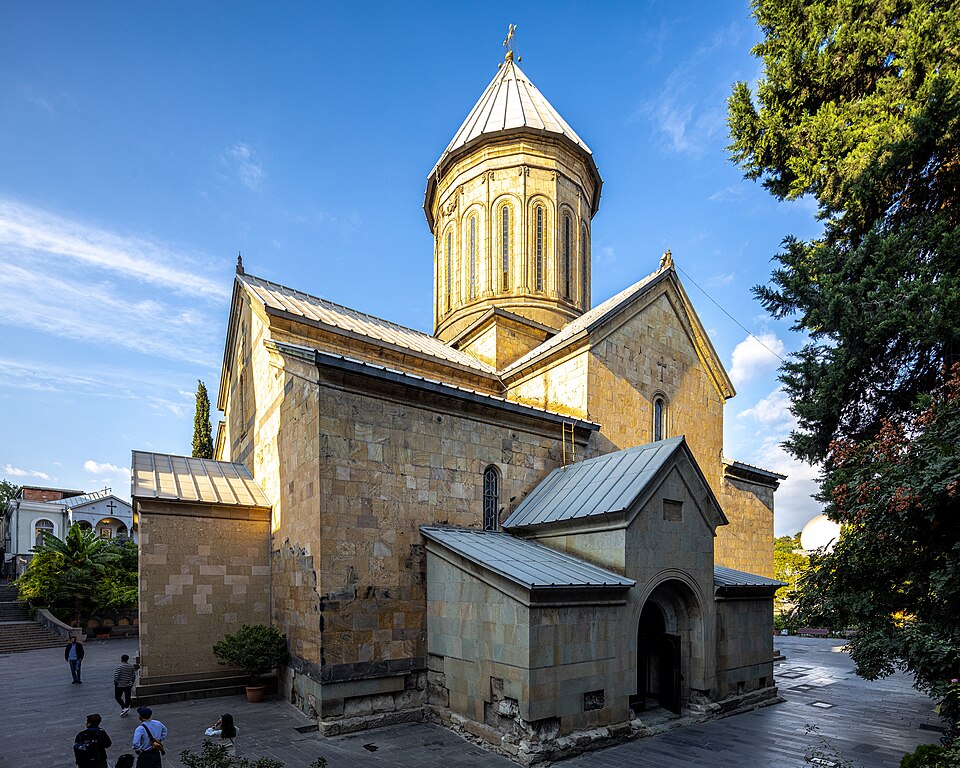
A tiered, drum-domed stone cathedral rises directly from a narrow old-town street beside the river, its cross-shaped plan and pale masonry the product of several rebuildings rather than one campaign.
An Orthodox cathedral first built in the sixth and seventh centuries on a street facing the river, and destroyed and reconstructed several times since by foreign invaders. The structure standing today is based on a thirteenth-century rebuilding, with further modifications made between the seventeenth and nineteenth centuries. It served as the seat of the Catholicos-Patriarch of All Georgia until that role passed to the Holy Trinity Cathedral in 2004.
- It follows a medieval Georgian custom of naming churches after places in the Holy Land, taking its name from Mount Zion in Jerusalem.
- It served as the country's senior cathedral until 2004, when that role moved to a newly consecrated church.
Photo: This Photo was taken by Supanut Arunoprayote. Feel free to use any of my images, but please mention me as the author and may send me a message. (สามารถใช้ภาพได้อิสระ แต่กรุณาใส่เครดิตผู้ถ่ายและอาจส่งข้อความบอกกล่าวด้วย) Please do not upload an updated image here without consultation with the Author. The author would like to make corrections only at his own source. This ensures that the changes are preserved. Please if you think that any changes should be required, please inform the author. Otherwise you can upload a new image with a new name. Please use one of the templates derivative or extract. (CC BY 4.0)
Tbilisi Opera and Ballet Theatre
1896 · Victor Schröter
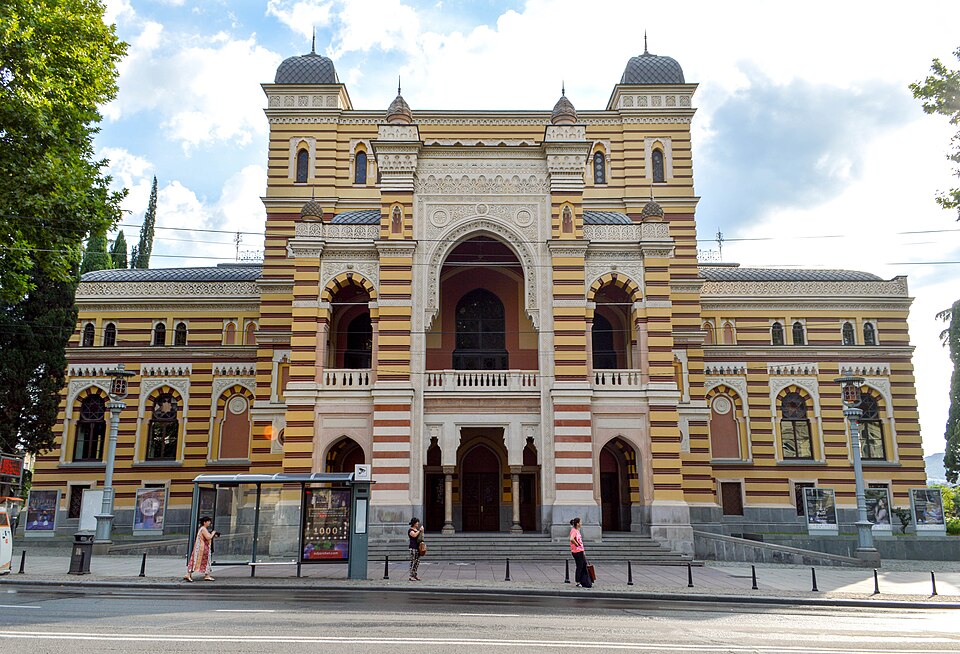
Horseshoe arches, striped brick and Oriental-revival ornament wrap a theatre building whose plan and grand hall inside are otherwise a standard European opera house.
An opera house built in 1896 to a neo-Moorish design by the Baltic German architect Victor Schröter, though the institution it houses had already been founded in 1851, making it one of the oldest opera companies in Eastern Europe. Fires have damaged the building repeatedly since, and it has undergone several rehabilitations under Soviet and Georgian governments, most recently a six-year restoration completed in January 2016.
- Its Oriental exterior encloses a conventional European opera house layout inside.
- The 1851 opera company predates the 1896 building it now occupies by 45 years.
- The most recent restoration took six years and cost about 40 million US dollars, funded by a Georgian business foundation.
Photo: Francisco Anzola (CC BY 2.0)
Holy Trinity Cathedral
The main cathedral of the Georgian Orthodox Church, built between 1995 and 2004, the third-tallest Eastern Orthodox cathedral in the world. Known as Sameba, it blends traditional Georgian church styles with Byzantine touches and ranks among the largest religious buildings in the world.
Bridge of Peace
A bow-shaped steel-and-glass pedestrian bridge over the Kura River, illuminated with numerous LEDs, linking Rike Park with the Old Town. Opened in 2010, it quickly became an important pedestrian crossing and one of the most recognized landmarks in the capital.
Freedom Square
A square at the eastern end of Rustaveli Avenue, in central Tbilisi. It has been known by several names over time, including Erivansky Square under Imperial Russia and, in Soviet times, Beria Square and then Lenin Square.
Anchiskhati Basilica
The oldest surviving church in Tbilisi, dating from the sixth century. It belongs to the Georgian Orthodox Church.
Kartlis Deda
A 20-meter aluminium statue of a woman in Georgian national dress, erected atop Sololaki hill in 1958. It was designed by prominent Georgian sculptor Elguja Amashukeli, unveiled in the year Tbilisi marked its 1,500th anniversary.
Georgian Parliament Building
The meeting place of the Parliament of Georgia on Rustaveli Avenue, built as the House of Government. Its 'upper' building, designed by Viktor Kokorin and Giorgi Lezhava, was built from 1933 to 1938, and the 'lower' building followed between 1946 and 1953.
National Youth and Children's Palace
A historic building on Rustaveli Avenue, also called the Pioneers' Palace, built in 1802 as the residence of the Commander-in-Chief of the Caucasus. It was rebuilt in 1818, remodeled by Nikolai Semyonov in 1847, and given a Renaissance look by Otto Jakob Simonson in 1869.
Norashen Church
A non-functioning Armenian Apostolic church in the Old Town, built in the early 16th century. Closed and confiscated by Soviet authorities in the 1930s, it was consecrated as a Georgian Orthodox church in 1995, sparking Armenian protests that led to its indefinite closure.
Rustaveli Avenue
The central avenue of Tbilisi, formerly Golovin Street, named after the medieval poet Shota Rustaveli and running about 1.5 kilometers from Freedom Square. It is lined with major buildings including the Parliament of Georgia, the Georgian National Opera Theater, and Kashveti Church.
Mtatsminda Pantheon
A necropolis in the churchyard of St David's Church on the slope of Mount Mtatsminda, officially established in 1929. The first to be buried there were Russian writer Alexander Griboyedov and his Georgian wife Nino Chavchavadze, marking the centenary of Griboyedov's death.
Juma Mosque
The only surviving mosque in the historic Old Town, at the foot of Narikala Fortress on Botanical Street. It is notable for being shared by both Sunni and Shia Muslims.
Art Palace of Georgia
A museum on Kargareteli Street, housed in the former palace of Count Oldenburg. Known until April 2020 as the Georgian State Museum of Theater, Music, Cinema and Choreography, it was renamed the Art Palace of Georgia by government resolution.
Great Synagogue
The largest synagogue in Georgia, built between 1904 and 1911 on what is now Kote Afkhazi Street. Also known as the Georgian Synagogue, it serves as the central house of worship for Tbilisi's Jewish community.
Presidential Palace
The official residence of the president of Georgia since November 2018, on Atoneli Street in central Tbilisi. Also called the Orbeliani Palace, it was once home to Elizabeth Orbeliani, a Georgian poet and the country's first female academic.
Writers' House of Georgia
A mansion in Sololaki built between 1903 and 1905 by entrepreneur David Sarajishvili, blending Art Nouveau and Neobaroque styles. A gathering place for Georgian writers in the 1920s, it was also where the poet Paolo Iashvili took his own life in 1937.
Mtatsminda Park
A landscaped amusement park at the top of Mount Mtatsminda, overlooking Tbilisi. It has carousels, water slides, a roller coaster, a dark ride, a funicular, and a large Ferris wheel at the mountain's edge with sweeping views of the city.
Kashveti Church
A Georgian Orthodox church across from the Parliament on Rustaveli Avenue, built between 1904 and 1910 after the medieval Samtavisi Cathedral. It replaced an earlier brick church from 1753, and its frescoes were painted in 1947 by the influential Georgian painter Lado Gudiashvili.
National Botanical Garden of Georgia
A 161-hectare botanical garden in the Tsavkisis-Tskali Gorge, with a collection of more than 4,500 taxonomic groups. Its history spans more than three centuries, first described as royal gardens in 1671 and later pillaged during the Persian invasion of 1795.
Chronicle of Georgia
A monument on Keeni Hill near the Tbilisi Sea, created by sculptor Zurab Tsereteli in 1985 but never fully finished. Its 16 pillars show kings, queens, and heroes above scenes from Christ's life, alongside a chapel and the grapevine cross of Saint Nino.
Open Air Museum of Ethnography
An open-air museum displaying folk architecture and craftwork from across Georgia, founded on 27 April 1966 by ethnographer Giorgi Chitaia. Since 30 December 2004 it has been administered as part of the Georgian National Museum.
Bank of Georgia headquarters
An 18-story building designed by architects George Chakhava and Zurab Jalaghania for the Ministry of Highway Construction of the Georgian SSR, finished in 1975. It was acquired by the Bank of Georgia in 2007.
Ceremonial Palace of Georgia
A governmental building in the Avlabari district, on the left bank of the Kura River, in a refurbished former Imperial gendarmerie building. Formerly the Avlabari Presidential Residence, it housed the President's administration before becoming home to the Ministry of Foreign Affairs in 2026.
Sultan Ezid Temple
A Yazidi temple in Tbilisi.
Tbilisi TV Broadcasting Tower
A free-standing communications tower built in 1972, standing 274.5 meters tall on a mountain 719.2 meters above sea level. Its predecessor, built in 1955, was moved to the vicinity of Gori, and the tower is now operated by the Georgian Teleradiocenter.
Radisson Blu Iveria Hotel
A 236-room hotel on Rose Revolution Square in the city center. It has a casino and spa, with good views of the Mtatsminda District.
History
Tbilisi was founded in the fifth century by Vakhtang I of Iberia, and its oldest surviving fabric reflects that long span: a hilltop stronghold and cliffside churches went up, burned, and were rebuilt across the medieval centuries as Georgian kingdoms and outside powers fought over the crossing between Europe and Asia. Annexation by the Russian Empire in 1801 brought a different kind of building: the city became seat of the Caucasus Viceroyalty, and Rustaveli Avenue filled with theatres and institutions in imported European and Oriental-revival styles. Later Soviet and post-Soviet construction added further layers, leaving a skyline the Wikipedia extract itself describes as a mix of medieval, neoclassical, Beaux Arts, Art Nouveau, Stalinist and modern structures.