Landmarks in Yerevan
Central Yerevan was rebuilt to one architect's plan, faced in pink and yellow tuff.
Yerevan's most recognisable landmarks date almost entirely from the twentieth century, after the city was replanned following Sovietisation. Alexander Tamanian, architect of the 1924 city plan, designed both Republic Square and the Opera Theatre, and his students carried the same vocabulary forward after his death in 1936. Republic Square's five surrounding buildings are faced in pink and yellow volcanic tuff, a neoclassical treatment layered with Armenian carved ornament, finished piecemeal between the 1950s and 1977. The Matenadaran, built in 1959 to a design by Mark Grigorian on a hill above the centre, breaks from Tamanian's ensemble to house a manuscript archive, its entrance marked by a single statue rather than a colonnade.
Republic Square
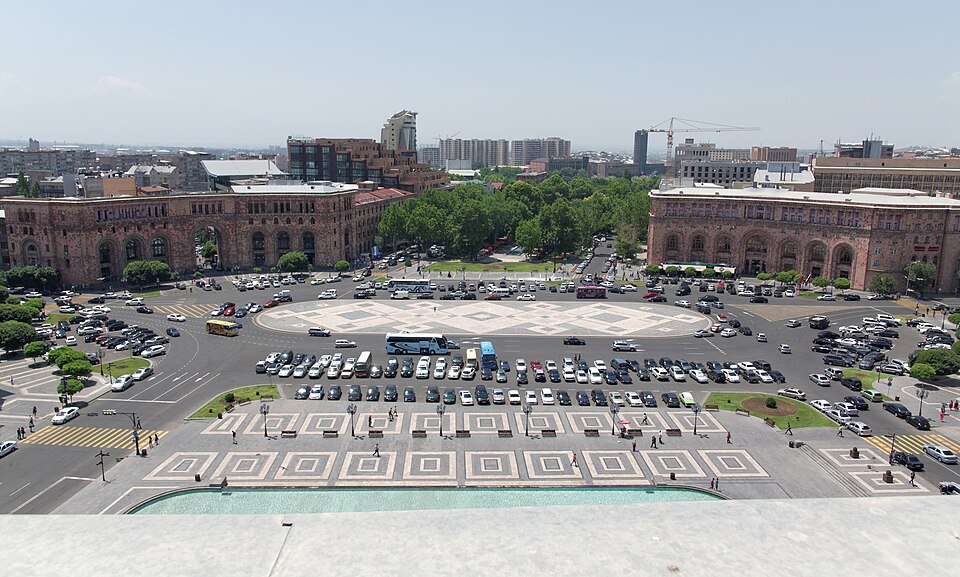
1924-1977 · Alexander Tamanian
Five government buildings in pink and yellow tuff, carrying matching neoclassical detailing and Armenian relief carving, ring an oval-to-trapezoid plaza whose lower half holds a fountain pool that performs to music.
The central square of Yerevan combines an oval roundabout with a trapezoid section holding a fountain pool. Alexander Tamanian designed it in 1924 as part of his plan for the city; the five surrounding buildings, including a government house, a history museum and a national gallery, were finished piecemeal through the 1950s, with the last completed in 1977, after Tamanian's death. Under Soviet rule it was called Lenin Square and held a statue of Lenin, removed after Armenia's independence; it later became the country's main site for demonstrations.
- Under Soviet rule the square was called Lenin Square and held a statue of Lenin, removed after independence.
- Twice a year, and originally three times, it hosted Soviet parades and celebrations until 1988.
- Its last building, the National Gallery, was completed in 1977, more than five decades after the square was designed.
Photo: Vyacheslav Argenberg (CC BY 4.0)
Yerevan Opera Theatre
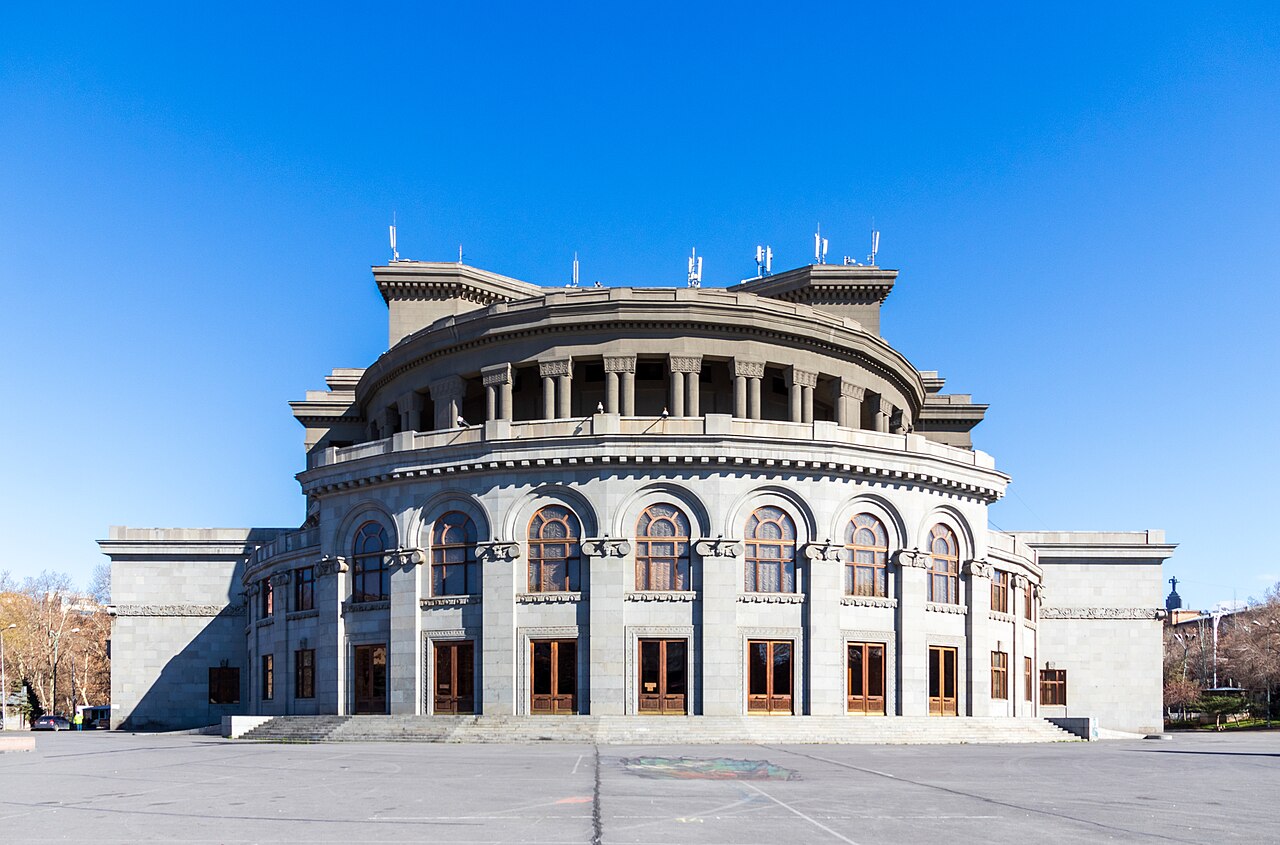
1933 · Alexander Tamanian
Known locally simply as 'Opera', it houses two separate auditoria under one roof: a smaller hall seating about 1,070 for opera and ballet, and a larger hall seating around 1,300, named for a composer and added through later renovation.
The Alexander Spendiaryan National Academic Opera and Ballet Theatre, designed by Alexander Tamanian, opened on 20 January 1933 with a performance of Spendiaryan's opera Almast; the building takes its name from that composer. It now holds two separate halls: the Aram Khachaturian Concert Hall, seating about 1,300, and the original Spendiaryan Opera and Ballet National Theatre, seating around 1,070. Known locally simply as 'Opera', it serves as Yerevan's principal venue for opera, ballet and orchestral concerts after several renovations.
- It opened with a performance of Alexander Spendiaryan's opera Almast, the composer the building is named for.
- Locals refer to it simply as 'Opera'.
Photo: Matthias Süßen (CC BY-SA 4.0)
Matenadaran
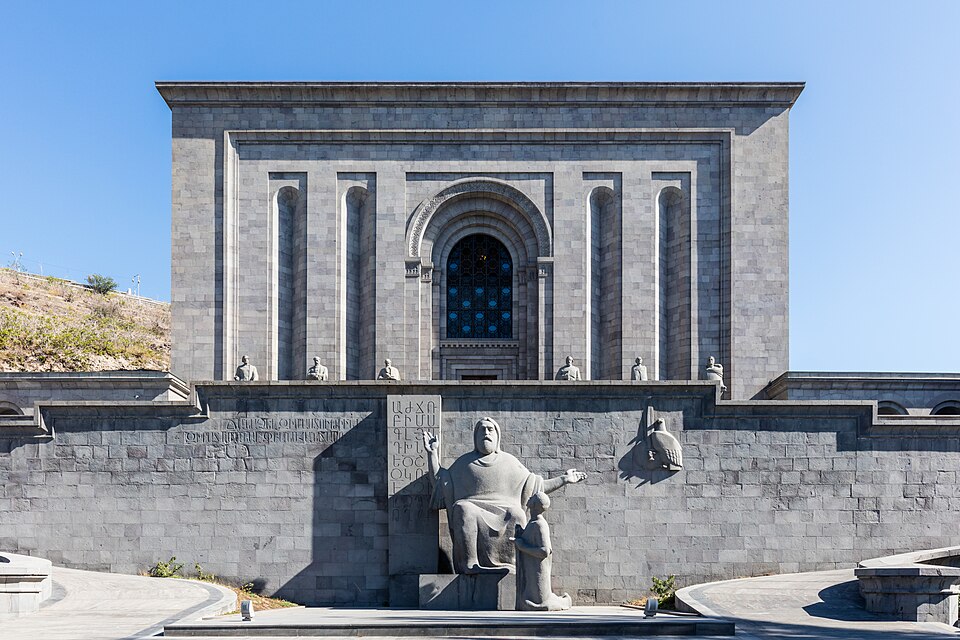
1959 · Mark Grigorian
A statue of Mesrop Mashtots, inventor of the Armenian alphabet, stands at the entrance to this repository, which holds the largest collection of Armenian manuscripts in existence and combines archive, museum and research-institute functions.
Officially the Mesrop Mashtots Institute of Ancient Manuscripts, the Matenadaran was established in 1959 from the nationalized manuscript collection of the Armenian Church, previously held at Etchmiadzin, and designed by Mark Grigorian. It combines the functions of a museum, an archive and a research institute, and holds the largest collection of Armenian manuscripts in existence. A statue of Mesrop Mashtots, inventor of the Armenian alphabet and the building's namesake, stands in front of it. Its collection is listed in UNESCO's Memory of the World register.
- Its collection is listed in UNESCO's Memory of the World register.
- The collection began with manuscripts nationalized from the Armenian Church's holdings at Etchmiadzin.
Photo: Diego Delso (CC BY-SA 4.0)
Blue Mosque
An 18th-century Iranian Shia mosque commissioned by Hoseyn Ali Khan, khan of the Erivan Khanate, and the only active mosque in Armenia. Secularized in the 1920s to house the History Museum of Yerevan, it was later renovated with Iranian support and reopened as a mosque.
Cascade
A multi-level staircase complex with terraces, fountains, sculptures and exhibition halls, connecting the city centre to the elevated Kanaker-Zeytun district. Part of the urban planning axis set out in architect Alexander Tamanyan's master plan, it is one of the city's most visited sites.
Saint Gregory the Illuminator Cathedral
The largest cathedral of the Armenian Apostolic Church, in the Kentron District, one of the largest religious buildings in the South Caucasus alongside Tbilisi's Sameba Cathedral. Adjacent to the General Andranik metro station, it is visible from many parts of the city.
Mother Armenia
A female personification of Armenia, most famously rendered as a monumental statue in Victory Park overlooking the capital.
Erebuni Museum
A museum established in 1968 to mark Yerevan's 2750th anniversary, at the foot of the Urartian fortress of Erebouni, built in 782 BCE. The fortress, built largely of raw brick, once housed a temple to the god Khaldi decorated with frescoes.
David of Sassoun
A copper equestrian statue of the folk hero David of Sassoun, erected by sculptor Yervand Kochar in 1959 in front of Yerevan's central railway station. An earlier version, erected in 1939 for the epic's thousandth anniversary, was destroyed two years later and its sculptor arrested.
National Gallery of Armenia
The largest fine arts museum in Armenia, on Republic Square, holding masterpieces by artists including Aivazovsky, Gorky, Chagall, Kandinsky, Donatello and Tintoretto. It also preserves fragments of medieval Armenian church frescoes from sites including Ani, Tatev and Haghpat, alongside an archive of about 200,000 items.
Hrazdan Stadium
Armenia's largest sports venue, opened in 1970 and used mainly for football, serving as the national team's home ground until 1999. A 2008 reconstruction converted it to an all-seater venue with 54,208 seats, down from an earlier capacity of up to 70,000.
History Museum of Armenia
Armenia's national museum, founded in 1920 on Republic Square, with departments of archaeology, numismatics, ethnography, modern history and restoration. Its 400,000-object collection is 45 percent numismatics, 35 percent archaeology, 12 percent documents and 8 percent ethnography.
Cafesjian Museum of Art
An art museum founded by Gerard L. Cafesjian in and around the Yerevan Cascade, opened in November 2009. It offers exhibitions of contemporary art plus lectures, films and concerts, drawing over a million visitors annually since it opened.
Freedom Square
Also known as Opera Square, and as Theatre Square until 1991, part of the Yerevan Opera Theater complex south of the opera building. Along with Republic Square, it is one of central Yerevan's two main squares, holding statues of Hovhannes Tumanyan and composer Alexander Spendiaryan.
Katoghike Church
A small medieval church in the Kentron District of Yerevan.
Saint Sarkis Cathedral
The seat of the Araratian Pontifical Diocese of the Armenian Apostolic Church, built in 1842 on the left bank of the Hrazdan River. It stands in Yerevan's Kentron District.
Victory Park
A public park in the Kanaker-Zeytun District of Yerevan.
Yerevan TV Tower
A 311.7-metre lattice tower built in 1977 on Nork Hill near downtown Yerevan, the tallest structure in Armenia. It ranks as the fourth-tallest tower in Western Asia, after Tehran's Milad Tower, and the 38th-tallest in the world.
Yerevan Circus
A circus founded in the 1930s and completely renovated in 1962. The building was demolished in September 2012, with a new one planned to open in October 2017.
Sergei Parajanov Museum
A museum dedicated to Soviet Armenian filmmaker and artist Sergei Parajanov, one of the most popular museums in Yerevan. It represents Parajanov's diverse artistic and literary heritage.
Moscow Cinema
A cinema hall in Charles Aznavour Square on Abovyan Street.
Shengavit
An archaeological site on a hill southeast of Yerevan Lake, inhabited from 3000 to 2500 BC during the Early Bronze Age Kura-Araxes period. Covering six hectares and ringed by a four-metre-wide stone wall, it served as a societal centre with surplus grain production and metalworking.
Komitas Pantheon
A park and pantheon in the Shengavit District, formed in 1936 after the demolition of the Mler cemetery and its chapel. It is named for and holds the grave of Komitas (1869–1935), founder of modern Armenian national music.
Botanical Garden
A botanical garden of the Armenian National Academy of Sciences, covering about 80 hectares in the Avan district of northeastern Yerevan. Its collection of more than 200 endemic, rare and declining plant species supports the study of Armenian flora.
Circular Park
Also known as the Youth Park, a half-circular public park running from the Cathedral of Saint Gregory in the south to Poplavok lake in the north. It stretches about 2,500 metres around the eastern part of downtown Yerevan, with an average width of 120 metres.
History
Yerevan's site has been settled since the fortress of Erebuni was founded in 782 BC, but the city that stands today owes almost nothing to that antiquity. The medieval town was emptied by forced deportations in 1603-05 and levelled by an earthquake in 1679, then rebuilt at a smaller scale. Russian annexation in 1828 brought repatriation and a slow revival, but the decisive break came after 1918, when Yerevan became Armenia's capital and, under Soviet rule, was rebuilt to a single plan by the architect Alexander Tamanian from 1924 onward. Civic buildings in pink and yellow tuff went up through the 1930s and 1950s, and construction under his successors continued for decades after his death, producing the square, theatre and archive that now define the centre.