Landmarks in Bangalore
A neoclassical courthouse, a Dravidian-revival legislature and a palace share one core.
Bangalore's set-piece government buildings sit around Cubbon Park rather than scattered through the city. The Attara Kacheri, a red-painted stone-and-brick courthouse in a neoclassical style, was raised in 1868 as the secretariat of the princely state of Mysore; directly opposite it stands the Vidhana Soudha, a far larger legislature completed in 1956 in a Dravidian-revival style that pairs Western institutional planning with South Indian temple forms. A third landmark, the nineteenth-century Bangalore Palace, sits apart from this civic cluster: built for the Mysore royal family, it now hosts public fairs and an amusement park rather than court functions. The result is less a single building campaign than layers of governance: princely-state offices, a post-independence legislature, and a private royal residence.
Vidhana Soudha
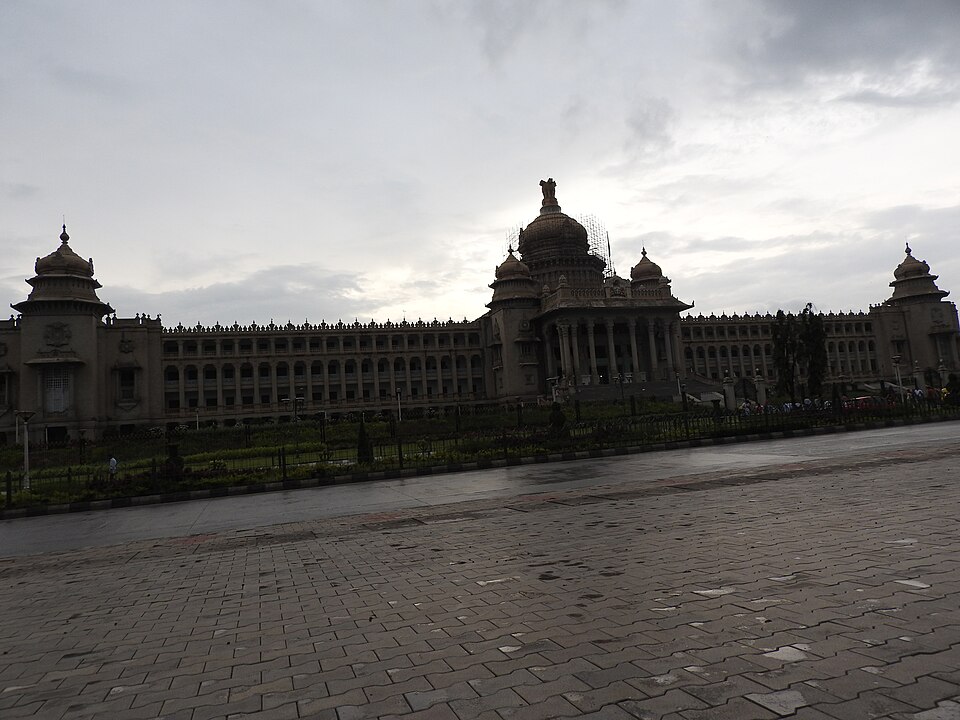
1956 · Kengal Hanumanthaiah
A large government building in the Neo-Dravidian style, a twentieth-century revival of South Indian temple forms, serving as the seat of a state's bicameral legislature — its two chambers held under one roof rather than in separate buildings.
Vidhana Soudha houses the Karnataka Legislative Assembly and the Karnataka Legislative Council, the state's bicameral legislature. It was completed in 1956 in the Neo-Dravidian style, credited to Kengal Hanumanthaiah. The building stands opposite Attara Kacheri, an older courthouse in the same civic quarter that once served as a princely state's secretariat, and it continues today as the working seat of state government.
Photo: Yercaud-elango (CC BY-SA 4.0)
Bangalore Palace
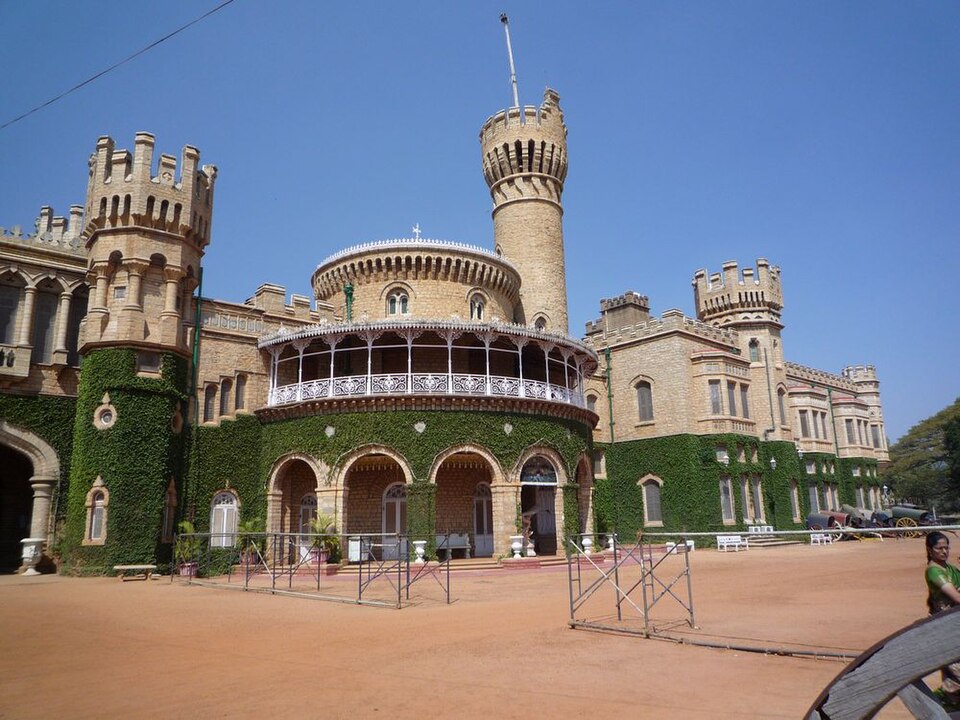
1874
A royal palace open to public viewing, identifiable less by a single distinctive facade than by its grounds, which today double as fairground space and host an amusement park beside the historic residence.
Bengaluru Palace was commissioned by the Maharaja of Mysore and completed in 1874, making it one of the city's older surviving palace buildings; Wikidata records give a slightly later completion year of 1878. Once a royal residence, it is now open to the public, and its grounds have become a venue for fairs and other events rather than court ceremony, and include an amusement park.
- A former Mysore royal residence, its grounds now double as a fairground and host a public amusement park rather than court ceremony.
Photo: Argographx (Public domain)
Attara Kacheri
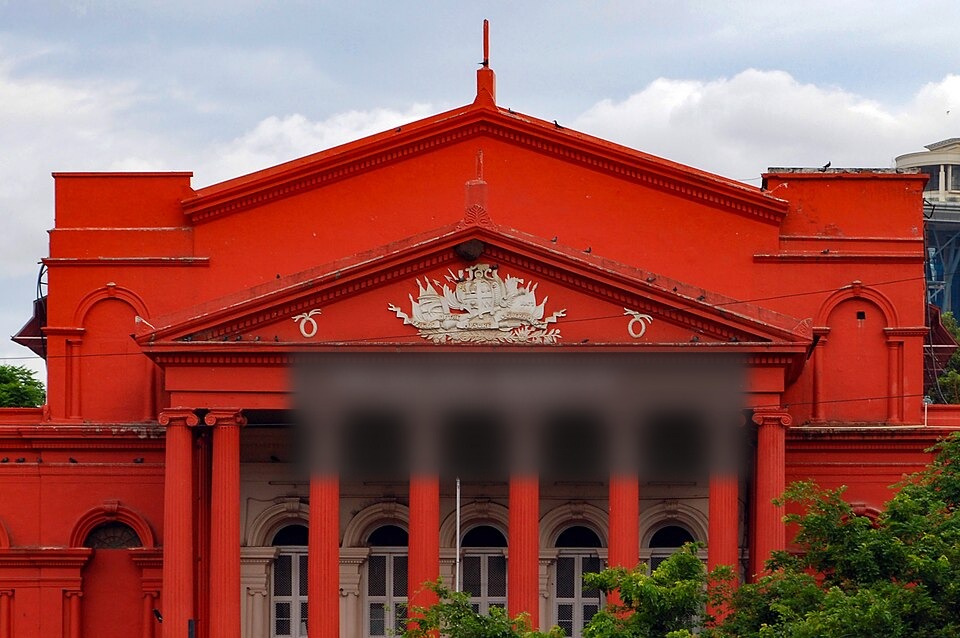
1868
A red-painted stone-and-brick building in the neoclassical style, standing in Cubbon Park directly opposite the Vidhana Soudha legislative building — a colour and material combination that sets it apart from its much larger neighbour.
Attara Kacheri, formerly the Old Public Offices Building, is a neoclassical red-painted stone-and-brick building in Cubbon Park. Completed in 1868, it originally housed the secretariat of the princely state of Mysore and later that of independent India's Mysore State. Today it serves as the seat of the principal bench of the Karnataka High Court, the state's highest judicial authority, standing on Dr. B. R. Ambedkar Road opposite the Vidhana Soudha.
- Before it became a courthouse, the building served twice as a government secretariat — first for the princely state of Mysore, then for the independent Indian state that succeeded it.
Photo: Moheen Reeyad (CC BY-SA 4.0)
Lal Bagh
A botanical garden first laid out by Hyder Ali in 1760, later expanded under a succession of British superintendents. Its glass house, built in 1890, still hosts flower shows twice a year, around Republic Day and Independence Day.
M. Chinnaswamy Stadium
A cricket ground in central Bengaluru, owned by the Government of Karnataka and leased to the Karnataka State Cricket Association for 100 years. It hosts Test, ODI and T20I matches, and serves as home ground for both Karnataka's and RCB's men's and women's teams.
Tipu Sultan's Summer Palace
An Indo-Islamic summer residence, its construction begun by Hyder Ali in 1781 within the walls of Bangalore Fort and completed by Tipu Sultan in 1791. Built entirely of teak with pillars, arches and balconies, it later served as the British administration's secretariat until 1868.
Karnataka High Court
The Attara Kacheri is a red-painted brick building that houses the principal bench of the Karnataka High Court, the state's highest judicial authority. It stands opposite the Vidhana Soudha, seat of the Karnataka Legislature, with additional court benches in Hubballi-Dharwad and Kalaburagi.
Dodda Basavana Gudi
A Hindu temple inside Bugle Rock park dedicated to Nandi, said to be one of the largest temples to the bull deity in the world. The stone idol is kept coated in fresh butter, and a groundnut fair is held each year during Karthika Maasa.
Gavi Gangadhareshwara Temple
A rock-cut cave temple built in the 16th century by Kempe Gowda I, the founder of the city. Its forecourt holds a set of stone discs positioned so that sunlight strikes the shrine directly at a certain time of year.
ISKCON Temple
One of the largest Krishna temples in the world, dedicated to Radha Krishna. It draws on the Chandogya Upanishad to teach a monotheistic view of Hindu devotion.
Sree Kanteerava Stadium
A multi-purpose stadium built on the bed of the former Sampangi Lake and inaugurated in 1946, now the largest sports complex in the city. It holds a running track, a volleyball court and two rock-climbing walls, its track resurfaced in 1997 for the National Games.
St. Mary's Basilica
A shrine in the Shivajinagar neighborhood, among the oldest churches in the city and the first in the state raised to the status of minor basilica. Each September its St. Mary's Feast draws devotees from across the metropolitan area.
St. Mark's Cathedral
A cathedral of the Church of South India, founded in 1808 and built in an English Baroque style inspired by the 17th-century St Paul's Cathedral. It stands at the west end of Mahatma Gandhi Road and is open to visitors of any faith.
Visvesvaraya Centre
A government office complex, also known as Visvesvaraya Towers, built on the site of Sir M. Visvesvaraya's former house after his death. It was first constructed for the Life Insurance Corporation before the state government bought it for its own offices.
St. Andrew's Church
A Presbyterian church on Cubbon Road, consecrated in 1866 as St Andrew's Kirk of the Church of Scotland. It joined the Church of South India in 1959 and was consecrated in memory of Mary Elizabeth McGoun, who died the following year.
Halasuru Someshwara Temple
A Hindu temple dedicated to Shiva, dating to the Chola period and expanded during the late Vijayanagara Empire under Hiriya Kempe Gowda II. It is one of the oldest and largest temples in the city, hosting Mahashivaratri and Brahmotsavam festivals each year.
Dharmaraya Swamy Temple
One of the oldest and most well-known Hindu temples in Bengaluru.
Visvesvaraya Industrial and Technological Museum
A science museum built in Cubbon Park in memory of Sir M. Visvesvaraya, inaugurated by Prime Minister Jawaharlal Nehru on July 14, 1962. The 4,000-square-metre building displays industrial products, scientific models and engines.
Museum of Art & Photography
A private art museum holding Indian art, textiles, photography, craft and design spanning the twelfth century to the present. Launched as a digital museum in 2020, it opened its physical doors on 18 February 2023 with a collection donated by founder Abhishek Poddar.
Karnataka Chitrakala Parishath
A visual-arts complex with 18 galleries, 13 of them holding a permanent collection of Mysore paintings, sculpture and leather puppets. It also runs a college of fine arts and hosts the annual Chitra Santhe art fair each January.
Daly Memorial Hall
A heritage building that houses the Mythic Society, a research institution founded in 1909. Built at a cost of ₹24,783, the hall was inaugurated on 25 July 1917 by the Yuvaraja of Mysore and named after Sir Hugh Daly, Resident of Mysore State.
National Military Memorial
A memorial park established by the Government of Karnataka in 2013. It honors soldiers who died in service of the nation, along with their families.
Statue of Queen Victoria
A statue at Queen's Park unveiled on 5 February 1906 by the Prince of Wales, later King George V. It is one of five original Queen Victoria statues in British India still standing at their original site, funded partly by the Maharaja of Mysore.
Statue of Edward VII
A statue at Queen's Park unveiled in November 1919 by the Viceroy, Lord Chelmsford, and paid for by residents of the Bangalore Civil and Military Station. Designed by Leonard Jennings, it is one of the few original British-India statues still standing at its original site.
Lok Bhavan
Formerly known as Raj Bhavan, this is the official residence of the Governor of Karnataka. Located in Bengaluru, it was constructed in the late 19th century.
History
Human settlement in the area goes back to around 4000 BCE, but the city's name first appears in a Kannada inscription of 890 CE at the Nageshwara Temple in Begur. Successive dynasties held the region — the Western Ganga dynasty from 350 CE, the Chola Empire from the early eleventh century, then the Hoysala kingdom and the Vijayanagara Empire — before Kempe Gowda I, a Vijayanagara feudal ruler, built a mud fort in 1537 that is counted as the city's founding; the older market settlements known as petes around it still exist. The colonial and princely-state era added the civic buildings that define the centre today: the Attara Kacheri courthouse in 1868 and Bangalore Palace in the 1870s, both predating the 1956 Vidhana Soudha, built after independence as the state legislature.