Landmarks in Colombo
A coastal capital pairing colonial civic halls with a red mosque and a 1953 monument.
Colombo's landmarks trace the city's shift from colonial port to national capital. Made the capital when the island was ceded to the British Empire in 1815, it acquired the civic buildings that colonial administration required: the neoclassical Town Hall, completed in 1928 opposite Viharamahadevi Park, was chosen from 32 competition entries to house the municipal council, a mayor's office and a library. In the old trading quarter of Pettah, the Jami Ul-Alfar Mosque, built in 1909 in the Indo-Saracenic style and predominantly red in colour, has stood among the district's commercial streets for over a century. After independence in 1948, Cinnamon Gardens gained a different kind of building, the 1953 Independence Memorial Hall, raised on the exact site where self-rule began.
Colombo Town Hall
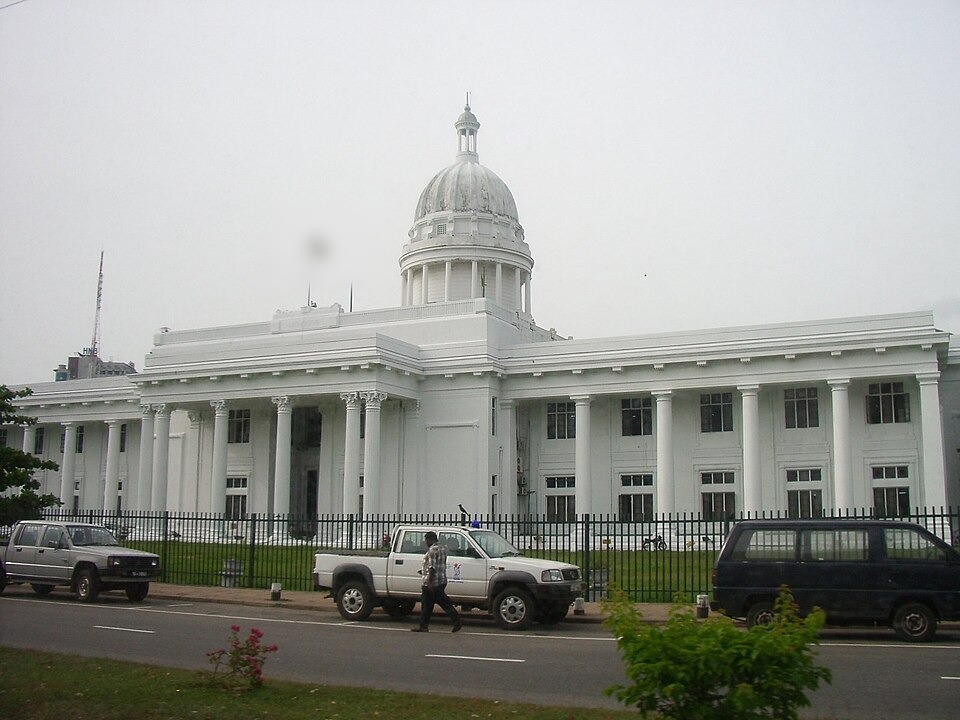
1928 · S. J. Edwards
A neoclassical civic building that fronts a large public park, its symmetrical form picked from 32 entries in an open design competition rather than drawn up by a single appointed architect.
Completed in 1928 in a neoclassical style, this building serves as the headquarters of the Colombo Municipal Council and the office of the mayor. Its construction followed a 1921 recommendation from town planner Patrick Geddes that the council build a dignified central municipal building with a council chamber, mayor's office and public library. An international design competition held in 1922 drew 32 entries; the winning scheme was submitted by S. J. Edwards of the firm Ralph Booty & Co. The building stands opposite Viharamahadevi Park.
- The public library the hall was meant to include was instead housed in a separate donated building, Sirinivasa, which today serves as the mayor's official residence.
- The winning design was picked from 32 submissions in an international competition held in 1922.
Photo: No machine-readable author provided. Jolle~commonswiki assumed (based on copyright claims). (CC BY-SA 3.0)
Jami Ul-Alfar Mosque
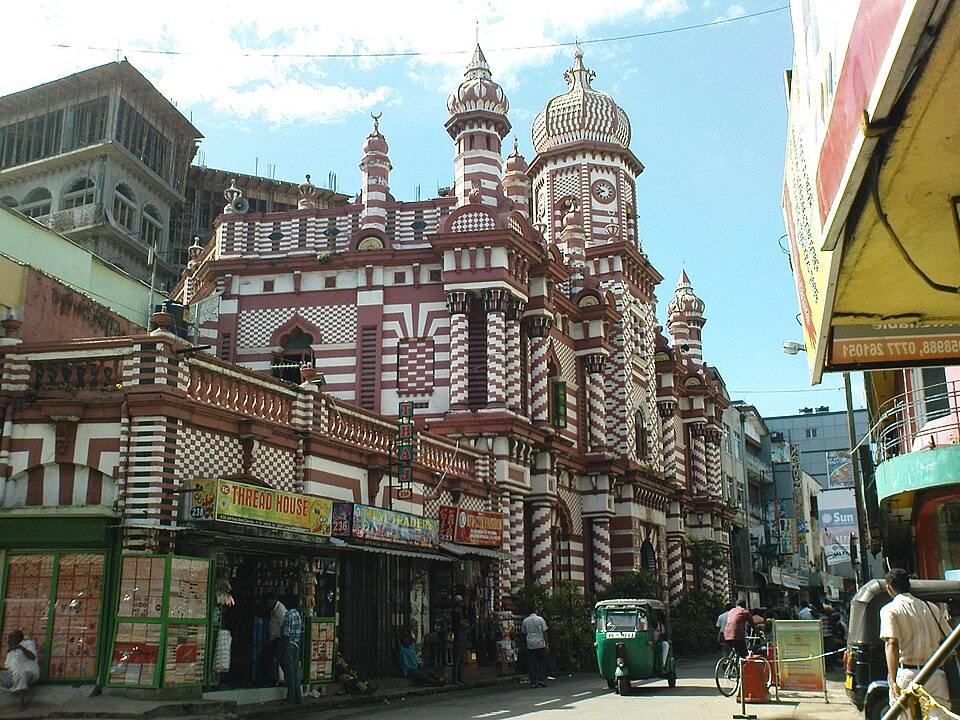
1909 · H. L. Saibo Lebbe
Coloured predominantly red — the source of its everyday nickname, the Red Mosque or Rathu Palliya — and built in the Indo-Saracenic style on a street in an old trading quarter.
Built in 1909 to a design by H. L. Saibo Lebbe, this mosque stands on Second Cross Street in the Pettah district and ranks among the oldest in the city. Its Indo-Saracenic architecture and overwhelmingly red exterior have earned it several local names, including Samman Kottu Palli, Rathu Palliya and simply the Red Mosque. It is a popular stop for visitors exploring Pettah's older streets.
- It is known locally by at least four different names, including Samman Kottu Palli and Rathu Palliya, alongside its official name.
Photo: Aksam Zarook (CC BY-SA 3.0)
Independence Memorial Hall
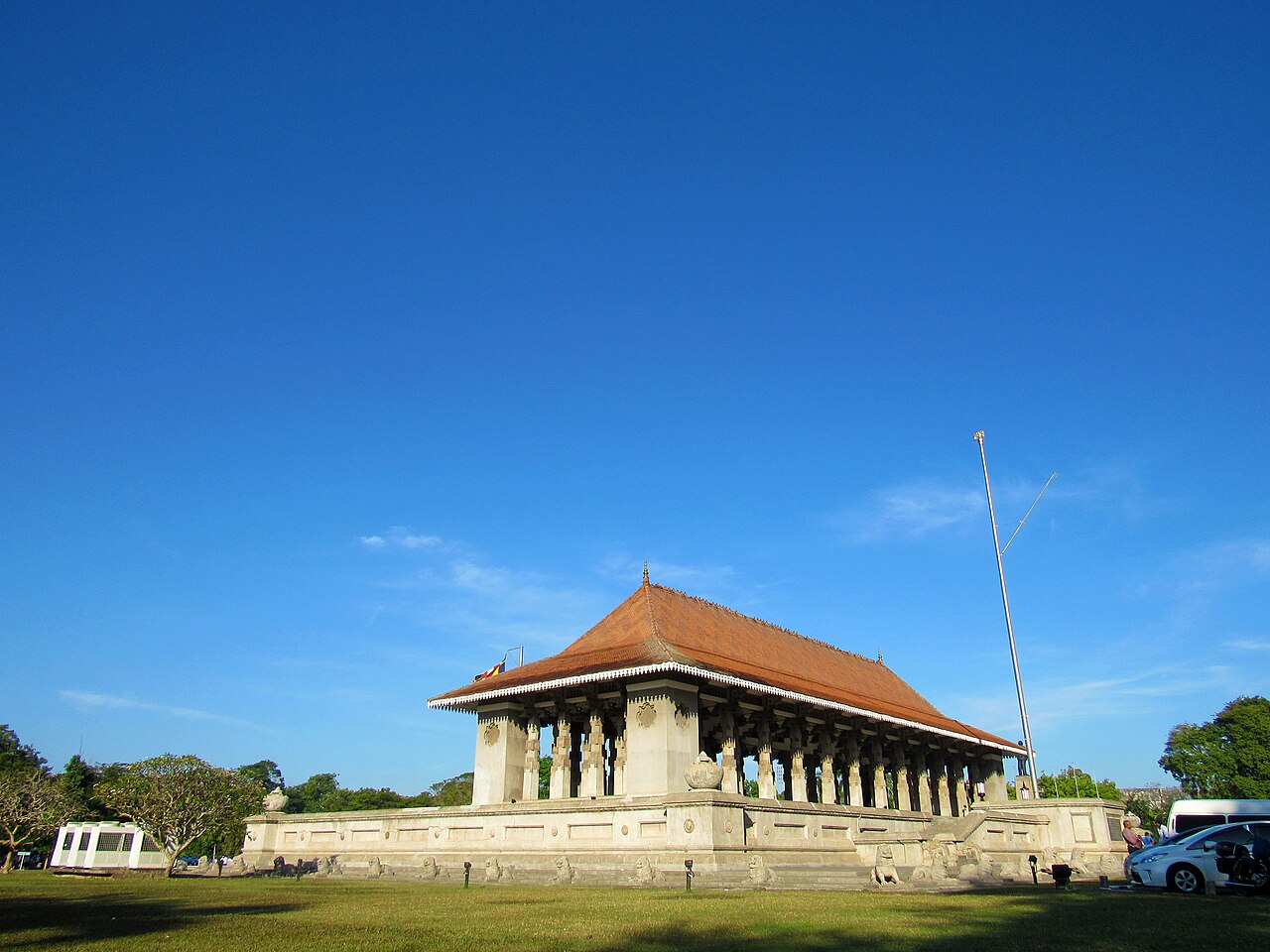
1953
A statue of the country's first prime minister, D. S. Senanayake, stands at the head of the hall, which occupies a square in Cinnamon Gardens and today also contains a museum.
Completed in 1953, this national monument stands in Independence Square, Cinnamon Gardens, on the site where Sri Lanka's first parliament opened under home rule on 4 February 1948, with Prince Henry, Duke of Gloucester presiding. A statue of the country's first prime minister, D. S. Senanayake, stands at the head of the hall. Beyond hosting annual independence-day ceremonies, the building served as the assembly chamber for the Senate and House of Representatives until parliament relocated, and it now also houses the Independence Memorial Museum.
- The building served for years as the actual assembly chamber for Ceylon's Senate and House of Representatives, not only as a monument.
- It stands on the exact spot where Prince Henry, Duke of Gloucester, opened the first parliament in 1948.
Photo: Charaka Ranasinghe (CC BY 2.0)
Galle Face Hotel
A hotel founded in 1864 on Galle Road, considered one of the oldest hotels east of Suez. It has won Best Heritage Hotel three years running at Sri Lanka's Presidential Awards for Travel and Tourism, and in 2012 appeared on a postage stamp.
Lotus Tower
A 351.5-meter lotus-shaped tower that, as of 2019, was the tallest self-supported structure in South Asia. Built at an estimated cost of US$113 million, it combines communication and observation facilities with leisure amenities.
Seema Malaka
A Buddhist temple set in Beira Lake, originally built in the late 19th century and used mainly for meditation and rest rather than worship. It forms part of the Gangaramaya Temple, situated a few hundred meters to its east.
Sri Lankan Parliament Building
The Parliament of Sri Lanka's home, built on an island surrounded by the Diyawanna Oya in Sri Jayawardenepura Kotte, the administrative capital. It was designed by the architect Geoffrey Bawa.
Old Parliament Building
A colonial-era building in the Colombo Fort area facing the sea, now home to the Presidential Secretariat of Sri Lanka. It housed the island's legislature for 53 years, until the new parliamentary complex opened at Sri Jayawardenepura in 1983.
R. Premadasa Stadium
Sri Lanka's largest cricket stadium, with a capacity of 35,000, known as Khettarama Stadium until June 1994. It hosted the 2012 ICC World Twenty20 final and saw the highest Test score in history, 952 runs by Sri Lanka against India.
Former General Post Office
The former headquarters of Sri Lanka Post, at 17 Janadhipathi Mawatha in the Colombo Fort district. It served as the office of the Postmaster General for over a hundred years, from 1895 until 2000.
St. Lucia's Cathedral
The seat of the Roman Catholic Archbishop of Colombo, located on 18,240 square feet of land in Kotahena. Its origins trace back to a small structure for worship built during the Dutch occupation.
Nelum Pokuna Mahinda Rajapaksa Theatre
A performing arts centre that opened on 15 December 2011. Originally planned as the National Performing Arts Theatre, it was renamed at its opening ceremony after President Mahinda Rajapaksa.
Mount Lavinia Hotel
A 275-room hotel originally built as the governor's residence in 1806. It has operated continuously as a hotel since 1947 and is recognized as one of the oldest and most famous in Sri Lanka.
Bandaranaike Memorial International Conference Hall
A convention center built between 1970 and 1973 as a gift from China in memory of Prime Minister Solomon Bandaranaike. It was constructed by a joint Sri Lankan and Chinese workforce, with a small exhibition center added on its grounds in 1998.
National Museum
Sri Lanka's largest museum, founded in 1877 and maintained by the Department of National Museums. Its collections include the regalia of the Kandyan monarchs, along with exhibits on the country's cultural and natural heritage.
Wolvendaal Church
A Dutch colonial-era church in Pettah, considered one of Sri Lanka's most important buildings from that period. It is also one of the oldest Protestant churches still in use in the country.
St. Anthony's Shrine, Kochchikade
A Catholic church in Kochchikade dedicated to Saint Anthony of Padua, designated both a national shrine and a minor basilica. A relic said to be a piece of the saint's tongue is preserved in a reliquary near the entrance.
Kelaniya Raja Maha Vihara
A Buddhist temple in Kelaniya, 11 kilometers northeast of Colombo. Popular tradition ties its fortunes to those of Sri Lanka itself, and the temple remains frequently visited by politicians from both government and opposition.
Old Lighthouse
A clock tower in the Colombo Fort district, at the junction of Chatham Street and Janadhipathi Mawatha, that once served as a lighthouse. Though no longer operational as a lighthouse, the tower still functions as a clock.
Kayman's Gate
A former entrance to the old Colombo Fort, located at the foot of Wolvendaal Hill in Pettah. Its historic free-standing bell tower still stands at the intersection of Main and 4th Cross Streets.
President's House
The official residence and workplace of Sri Lanka's president, home to British colonial governors from 1804 as the 'King's House' or 'Queen's House' until 1972. Twenty-nine governors and six presidents have resided there, most recently Gotabaya Rajapaksa, until protestors stormed and occupied the compound.
Sri Subodharama Raja Maha Vihara
A historic Buddhist temple at the Dehiwala junction on the Colombo-Galle main road, about nine miles south of the city. It was formally recognized as an archaeological site by the Sri Lankan government on 23 February 2007.
Arcade Independence Square
A shopping complex housed in renovated buildings that once served as the Jawatta Lunatic Asylum and the Western Provincial Council Building. It was created as part of the national government's Independence Square Redevelopment programme.
World Trade Center Colombo
A 152-meter twin tower complex, each of its 39 office floors built atop a four-story retail podium for a total of 43 floors. It is owned and managed by Overseas Realty Ceylon PLC.
Old Army Headquarters
The former headquarters complex of the Sri Lanka Army, bordering the Beira Lake next to Galle Face Green. It once held the Ministry of Defence, regimental centers, the Colombo Military Hospital and army sports grounds, before units began relocating in 2012 for redevelopment.
Pettah Floating Market
A tourist market of 92 trade stalls on Bastian Mawatha in Pettah, some built on boats on Beira Lake. Developed by the Urban Development Authority at a cost of Rs. 150 million, with the Sri Lanka Navy rehabilitating the polluted canal alongside it.
Kotte Raja Maha Vihara
A historic Buddhist temple in Sri Jayawardenepura Kotte, near the Pita Kotte Gal Ambalama at the Pita Kotte junction. Formally recognized as an archaeological site in 2013, its name, Raja Maha Vihara, denotes an ancient temple that received royal patronage.
Temple Trees
The official residence of the Prime Minister of Sri Lanka. Several recent presidents have also used it as their official residence.
History
Colombo became the island's capital in 1815, when Ceylon was ceded to the British Empire, and the city's older civic buildings date from the decades of colonial rule that followed. The Jami Ul-Alfar Mosque, built in 1909 by H. L. Saibo Lebbe in the Pettah trading quarter, and the Town Hall, completed in 1928 after an international design competition, both belong to this period of British administration. Colombo kept its status as capital when Sri Lanka gained independence in 1948, an event marked five years later by the Independence Memorial Hall of 1953, raised on the square where the first parliament under self-rule convened. In 1978, when the country's administrative functions moved to Sri Jayawardenepura Kotte, Colombo was redesignated the commercial capital, a role its status as the island's financial centre still carries today.