Landmarks in Chennai
Dravidian temple towers and British Gothic Revival buildings share Chennai's coastal grid.
Chennai's oldest landmark, the Kapaleeshwarar Temple in Mylapore, is built in the Dravidian style around clustered shrines and halls, predating the city's colonial history by roughly a millennium. Toward the coast, San Thome Basilica occupies the site of a Portuguese church raised in 1523 over the apostle Thomas's tomb, rebuilt in neo-Gothic form in 1896 to suit tastes British architects favoured at the time. Inland, Chennai Central railway station, begun in 1873 and reworked in 1900, combines Gothic Revival and Romanesque detailing across a far larger footprint. The three buildings together trace a path from a pre-colonial temple town through a Portuguese and British trading settlement into a colonial rail hub, in stone, brick and granite rather than any single material or period.
Kapaleeshwarar Temple
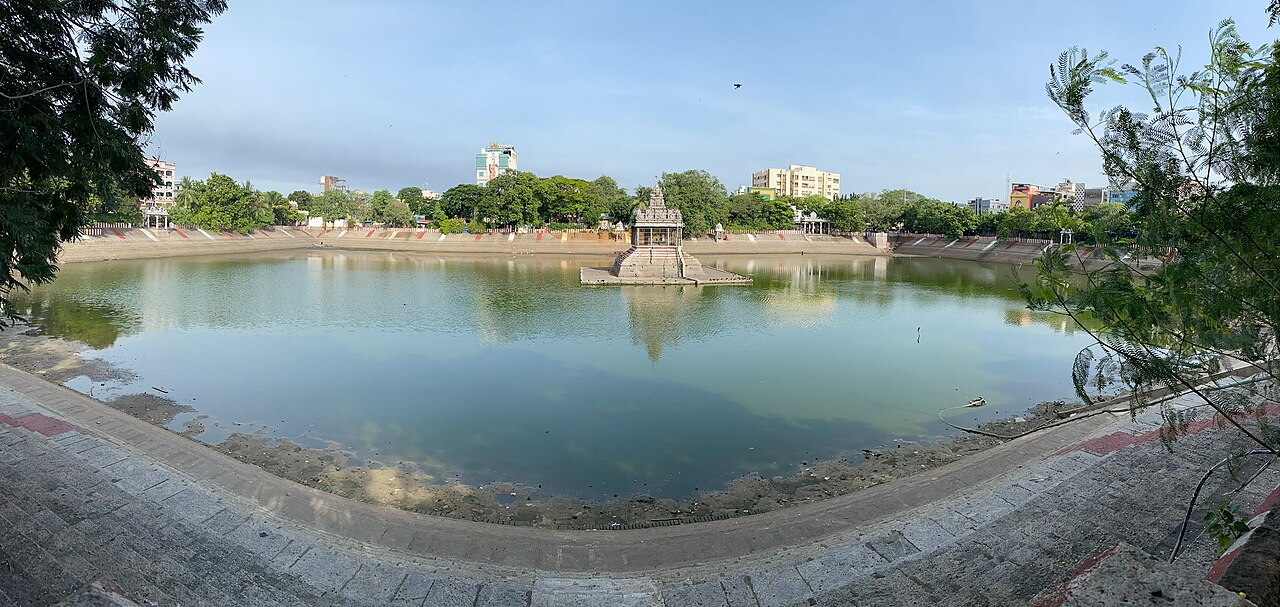
7th century
Its Dravidian-style compound holds two principal sanctums rather than one — Shiva worshipped here as a lingam under the name Kapaleeshwarar, and his consort Parvati as Karpagambal, goddess of the wish-yielding tree — set among numerous smaller shrines and halls inside a single walled precinct.
The Kapaleeshwarar Temple is a Hindu temple in Mylapore dedicated to Shiva, worshipped here as Kapaleeshwarar and represented by a lingam, alongside his consort Parvati as Karpagambal. Built around the seventh century in the Dravidian style, it is one of Chennai's oldest structures, predating the city's colonial development by roughly a millennium. The complex holds numerous shrines and halls around its two main sanctums. It observes six daily rituals and four annual festivals, the most prominent being the Aṟupatimūvar celebration during the Tamil month of Panguni, and is administered by the Tamil Nadu government's Hindu Religious and Charitable Endowments Department.
- According to legend, Parvati once worshipped Shiva in the form of a peahen, or mayil in Tamil — said to be the origin of the neighbourhood's name, Mylapore.
- Its presiding deity is celebrated in the Tevaram, a seventh-century Tamil canon of hymns composed by poet-saints known as the Nayanars.
Photo: KurinchiRays (CC BY 4.0)
San Thome Basilica
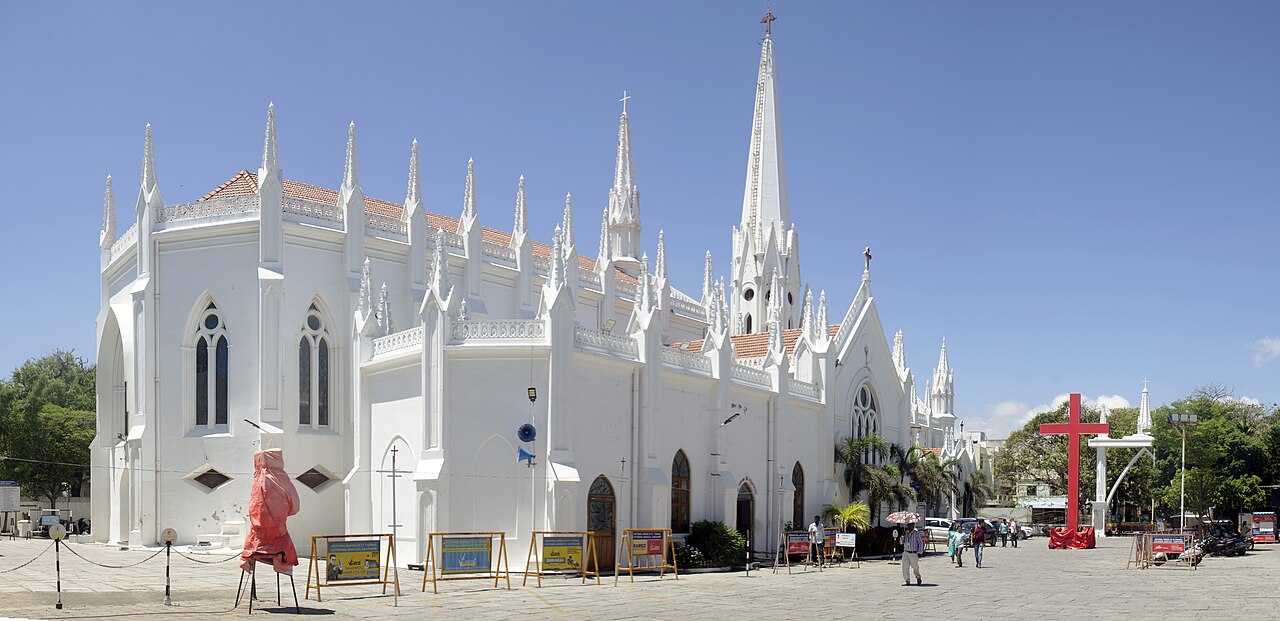
1523–1896
Pointed arches and vertical Gothic Revival tracery cover its exterior, the neo-Gothic style British architects favoured in Madras during the late nineteenth century, giving this cathedral basilica a silhouette unlike the Dravidian temple towers found elsewhere in the city.
San Thome Basilica, formally the National Shrine of St. Thomas Cathedral Basilica, is a Catholic cathedral in Chennai's Santhome neighbourhood, seat of the Archdiocese of Madras-Mylapore. It stands over the tomb of the apostle Thomas; the Portuguese built the first structure on the site in 1523. The building was renovated to its present neo-Gothic design in 1896, a style favoured by British architects of the period, and solemnly consecrated on 1 April 1896 by the Bishop of Madras. It holds the rank of minor basilica within the Catholic Church.
- Its 1896 consecration was carried out by the Bishop of Madras, assisted by the Bishop of Dhaka, in present-day Bangladesh.
Photo: Rangan Datta Wiki (CC BY-SA 4.0)
Chennai Central railway station
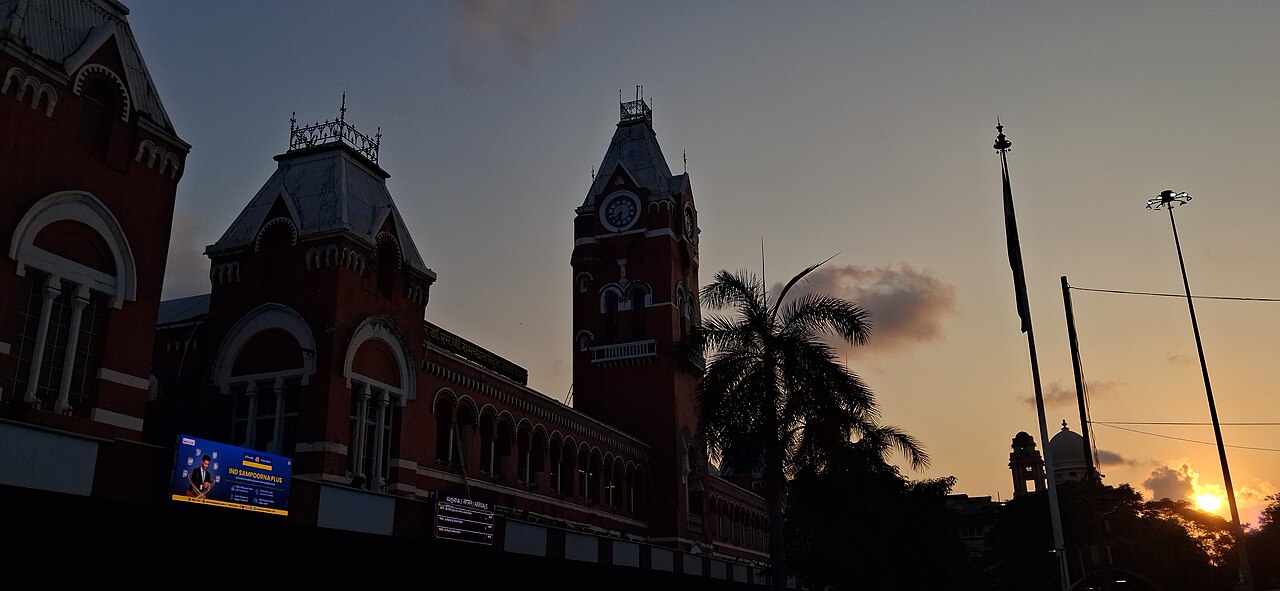
1873 · George Harding
The terminus building's exterior combines Gothic Revival and Romanesque detailing, added when a second architect reworked the original 1873 design in 1900 — a mixed masonry style that made it one of the city's most prominent landmark buildings.
Chennai Central, formally the Puratchi Thalaivar Dr. M.G. Ramachandran Central Railway Station, is a railway terminus built in 1873 to designs by George Harding and reworked in 1900 by Robert Chisholm in a mixed Gothic Revival and Romanesque style. It served as the terminus of the Madras Railway, later joining the Madras and Southern Mahratta Railway in 1908 and the Southern Railway zone of the Indian Railways in 1951. The station underwent further modifications and expansions in 1959, and its lines were electrified in 1979. It remains a major hub for intercity and suburban trains.
- Electrification of its tracks did not arrive until 1979, more than a century after the station opened in 1873.
- Its full official name honours a former Tamil Nadu chief minister, though it is still widely known by its former name, Madras Central.
Photo: Starstuffseyyon (CC BY-SA 4.0)
Marina Beach
A natural sandy beach along the Bay of Bengal, running 6 kilometres from Fort St. George to Foreshore Estate. Swimming is legally prohibited due to a turbulent undercurrent, yet it draws roughly 30,000 visitors on weekdays and up to 50,000 on weekends.
Fort St. George
A fortress founded in 1639 as the first English fortress in India. Its construction spurred the settlement that grew into the city once called Madras, and the fort now houses the Tamil Nadu legislative assembly.
Parthasarathy Temple
A 6th-century Hindu temple dedicated to Vishnu, built by the Pallava king Narasimhavarman I in the Thiruvallikeni neighbourhood. It is one of the 108 Divya Desams and houses icons of five forms of Vishnu, including Rama and Krishna as Parthasarathy.
Madras High Court
One of India's oldest high courts, established in 1862 by Letters Patent from the British Crown. It replaced the Supreme Court of Madras, which had held jurisdiction over the city since 1817, and functioned in a makeshift building until 1892.
Valluvar Kottam
A monument dedicated to the classical Tamil poet-philosopher Valluvar. It is described as the city's biggest Tamil cultural centre.
M. A. Chidambaram Stadium
A cricket stadium in Chepauk established in 1916, the second-oldest international cricket ground in India after Eden Gardens. Known as Chepauk Stadium, it hosts the Indian cricket team and serves as home ground for the IPL's Chennai Super Kings.
Government Museum
Built in Indo-Saracenic style and opened in 1851, it is the second-oldest museum in India after Kolkata's Indian Museum. Also known as the Madras Museum, it holds one of the largest collections of Roman currency outside Europe and 500 bronze idols dating to 1000 BCE.
St. George's Cathedral
A Church of South India cathedral built in 1815, known for its tall spire and marble statues and memorials inside. The Church of South India was inaugurated here on 27 September 1947, breaking down ecclesiastical barriers between Protestant traditions.
Thiruvalluvar Temple
A temple in Mylapore dedicated to the poet-saint Valluvar, believed to have been built in the early 16th century and extensively renovated in the 1970s. It is traditionally regarded as Valluvar's birthplace and is the oldest temple ever built to him.
Victoria Public Hall
A historical hall named after Victoria, Empress of India, built to commemorate her Golden Jubilee. Once used as a theatre and venue for public gatherings in the late 19th and early 20th centuries, it now houses the South Indian Athletic Association Club.
LIC Building
A 15-storey building on Anna Salai, the southern headquarters of the Life Insurance Corporation of India and the first skyscraper built in the country. Completed in 1959 at 54 metres, it was India's tallest building until 1961 and remained Chennai's tallest for over 35 years.
Chepauk Palace
The official residence of the Nawab of Arcot from 1768 to 1855, in the Chepauk neighbourhood. It is built in the Indo-Saracenic style of architecture.
Marundeeswarar Temple
A Shiva temple in Thiruvanmiyur beside the Bay of Bengal, with a masonry structure built during the Chola dynasty in the 9th century. It was widely expanded by the Cholas in the 11th century and later by Vijayanagar rulers, and has two seven-tiered gateway towers.
Triplicane Big Mosque
A Mughal-style mosque completed in 1795 by the family of Muhammad Ali Khan Wallajah, the Nawab of Arcot. Built entirely of granite without iron or wood, it is the largest and one of the oldest mosques in Chennai, still active as a place of worship.
Vadapalani Andavar Temple
A Hindu temple dedicated to Lord Muruga, renovated in the 1920s when its Rajagopuram tower was built. Its popularity is believed to owe partly to the patronage of cinema stars.
Armenian Church
Also called Saint Mary Church, it was built in 1712 and reconstructed in 1772 on Armenian Street in George Town. It is one of the oldest churches on the Indian subcontinent and is known for its belfry of six bells.
Connemara Public Library
A library in Egmore established in 1890 and opened to the public in 1896, one of only four National Depository Libraries in India. It also serves as a depository library for the United Nations and stands within the Government Museum Complex on Pantheon Road.
Semmozhi Poonga
The city's first botanical garden, opened on 24 November 2010 at the Cathedral Road–Anna Salai junction, covering 20 acres. It grows more than 500 plant species alongside 80 older trees on the site, some over a century old.
Anna Nagar twin arches
Twin ornamental arches built in 1986 to honor Tamil Nadu chief minister C. N. Annadurai's platinum jubilee, each 52 feet tall and weighing 82 tonnes. They mark the southern entrance to the Anna Nagar suburb named after him, designed by sculptor Ganapathy Sthapathi.
Kaj Schmidt Memorial
A memorial at Elliot's Beach commemorating a Danish sailor who drowned in 1930 while trying to save a woman's life. Left derelict for years, it has been under restoration since 2013.
Kandaswami Temple, Georgetown
A Hindu temple dedicated to Murugan in the Parry's Corner neighbourhood, popularly known as Kandha Kottam. It runs associated schools and a college and carries out social welfare work, including free medical clinics and pharmacies.
Kalikambal Temple
A Hindu temple dedicated to Kaligambal, also known as Kamakshi, and Kamadeswarar, in the Parry's Corner locality. It stands on Thambu Chetty Street, a financial street in Georgetown running parallel to Rajaji Salai.
Equestrian statue of Thomas Munro
A bronze equestrian statue of Thomas Munro, Governor of Madras from 1820 to 1827, sculpted by Francis Chantrey in 1834 and shipped to the city in 1839. It is nicknamed "The Stirrupless Majesty" for its notable lack of stirrups.
Tholkappia Poonga
An ecological park in the Adyar estuary, covering 358 acres to restore the area's fragile freshwater ecosystem. Also known as Adyar Eco Park, it holds tropical evergreen forest with over 160 woody species and was opened by Chief Minister M. Karunanidhi.
History
Archaeological evidence places settlement in the area back to the Stone Age, and from the first century CE the region passed through the Chola, Pallava, Pandya and Vijayanagara kingdoms, whose temple-building traditions produced structures such as the Kapaleeshwarar Temple. Portuguese traders reached the coast in the early sixteenth century, building a church over the apostle Thomas's tomb in 1523. In 1639, the British East India Company obtained a grant to coastal land holding the fishing village of Madrasapattinam, developing Madras port and building Fort St. George, the first British fortress in India. Britain and France then contended for the city through the eighteenth century. The Greater Chennai Corporation, incorporated in 1688, is the second-oldest municipal corporation in the world after the City of London Corporation, and the city's nineteenth-century growth as a colonial port produced the Gothic Revival buildings that now stand alongside the older temple architecture.