Landmarks in Mumbai
Colonial-era Indo-Saracenic and Gothic stone landmarks cluster along the harbour.
Mumbai's best-known landmarks stand within a few hundred metres of one another in Colaba and Fort, the harbourside districts built up while the city was a colonial seaport. The Gateway of India, a basalt triumphal arch finished in 1924, faces the Arabian Sea from the same stretch of waterfront as the Taj Mahal Palace Hotel, opened in 1903 and later extended with a separate, architecturally distinct tower. A few streets inland, Chhatrapati Shivaji Terminus carries the same era's taste for Indo-Saracenic and Gothic Revival detailing into a working railway station, its turreted stone facade still handling long-distance and suburban trains. All three date from the decades either side of 1900, when land reclamation and new railways had turned the original seven islands into one seaport city.
Gateway of India
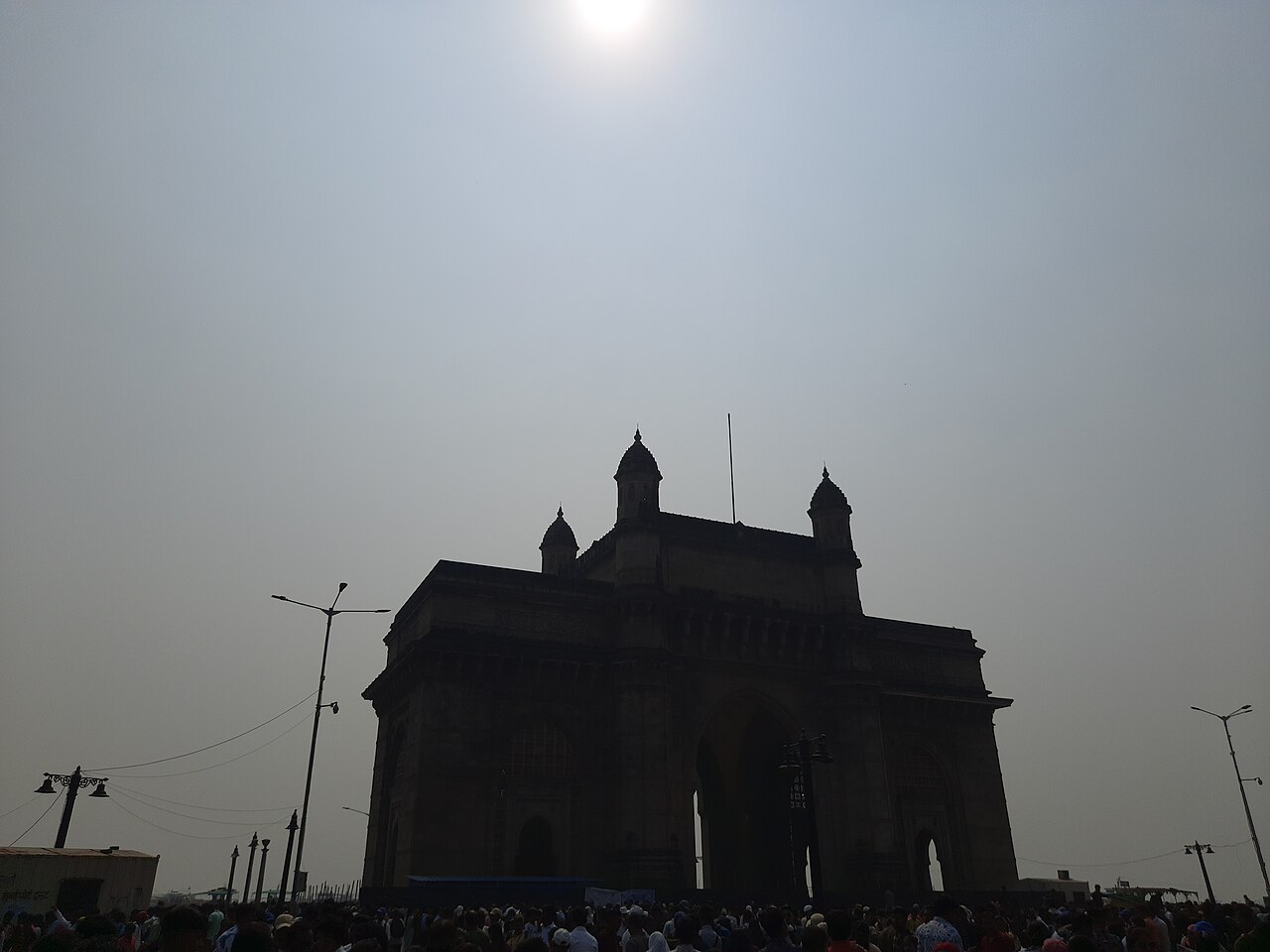
1924 · George Wittet
A single freestanding arch of dark basalt, about 26 metres high, combining Indo-Saracenic detailing with elements borrowed from centuries-older Gujarati architecture, standing alone at an angle to the water and facing the sea.
This memorial arch was built to commemorate the 1911 landing of a British king who came to be crowned emperor of India, the first reigning monarch to visit the country. Its foundation stone was laid in 1913, but the final design was not approved until 1914, and construction ran on to 1924. Afterward it served as a ceremonial entrance for arriving officials, and it was the point from which the last British troops departed in 1948, a year after independence.
- The design was approved only in 1914, a year after its foundation stone was laid.
- It stands at an angle to the shoreline, facing the sea rather than square to the waterfront road.
Photo: Darshula (CC0)
Chhatrapati Shivaji Terminus
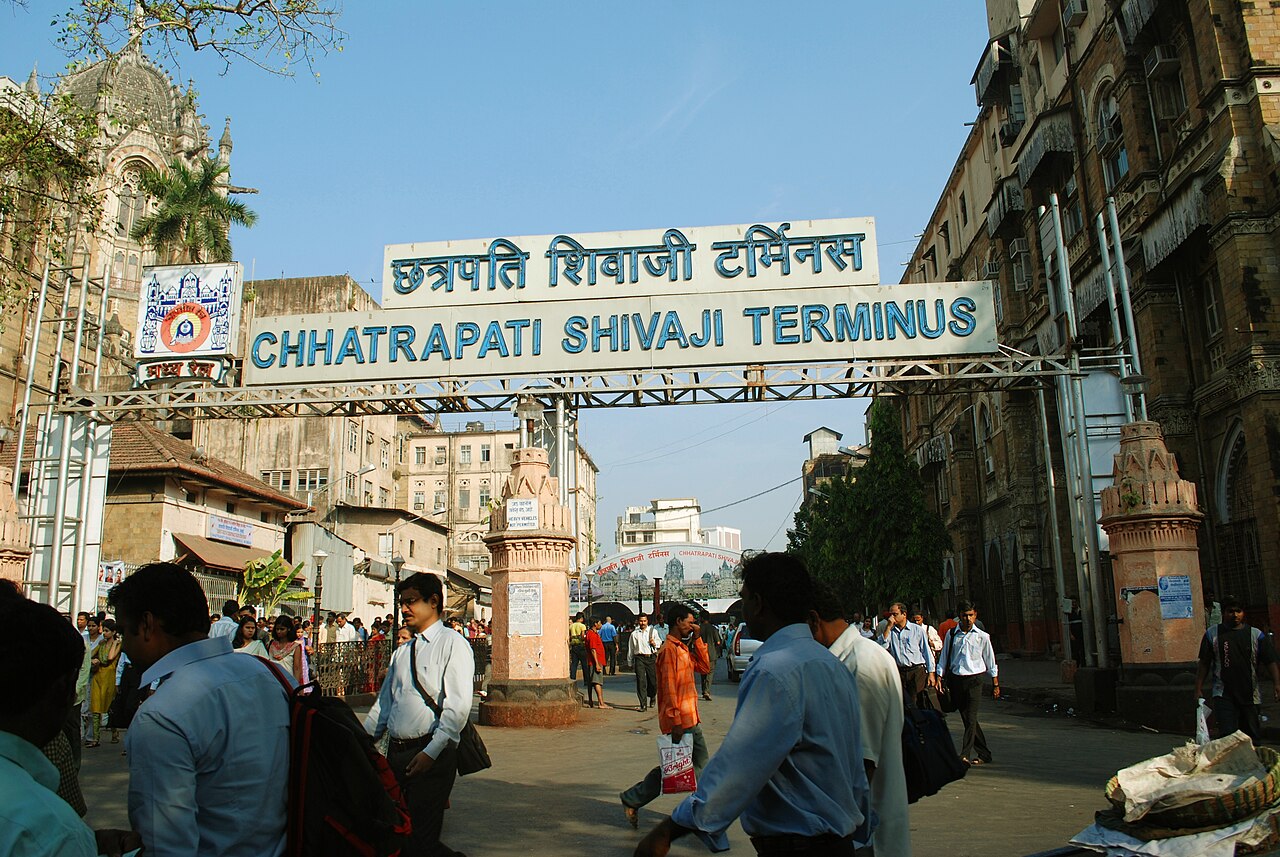
1878–1888 · Frederick William Stevens
An immense railway terminus in an exuberant Indo-Gothic style, its long, symmetrical stone facade crowned with domes and turrets, opening onto eighteen platforms still in daily use.
This railway terminus was designed by engineer Frederick William Stevens, developing an initial design by Axel Haig, in an exuberant Indo-Gothic style. Construction began in 1878 and finished in 1887, the year of Queen Victoria's Golden Jubilee, and the station opened to the public in May 1888. It has been renamed twice since, and now serves as headquarters of a regional railway zone and one of the busiest stations in the country, handling long-distance and suburban trains across eighteen platforms.
- It has been renamed twice: once in 1996 and again in 2017.
- Construction finished in 1887, the year of Queen Victoria's Golden Jubilee, though the public opening waited until the following May.
Photo: Vegpuff (CC BY-SA 3.0)
Taj Mahal Palace Hotel
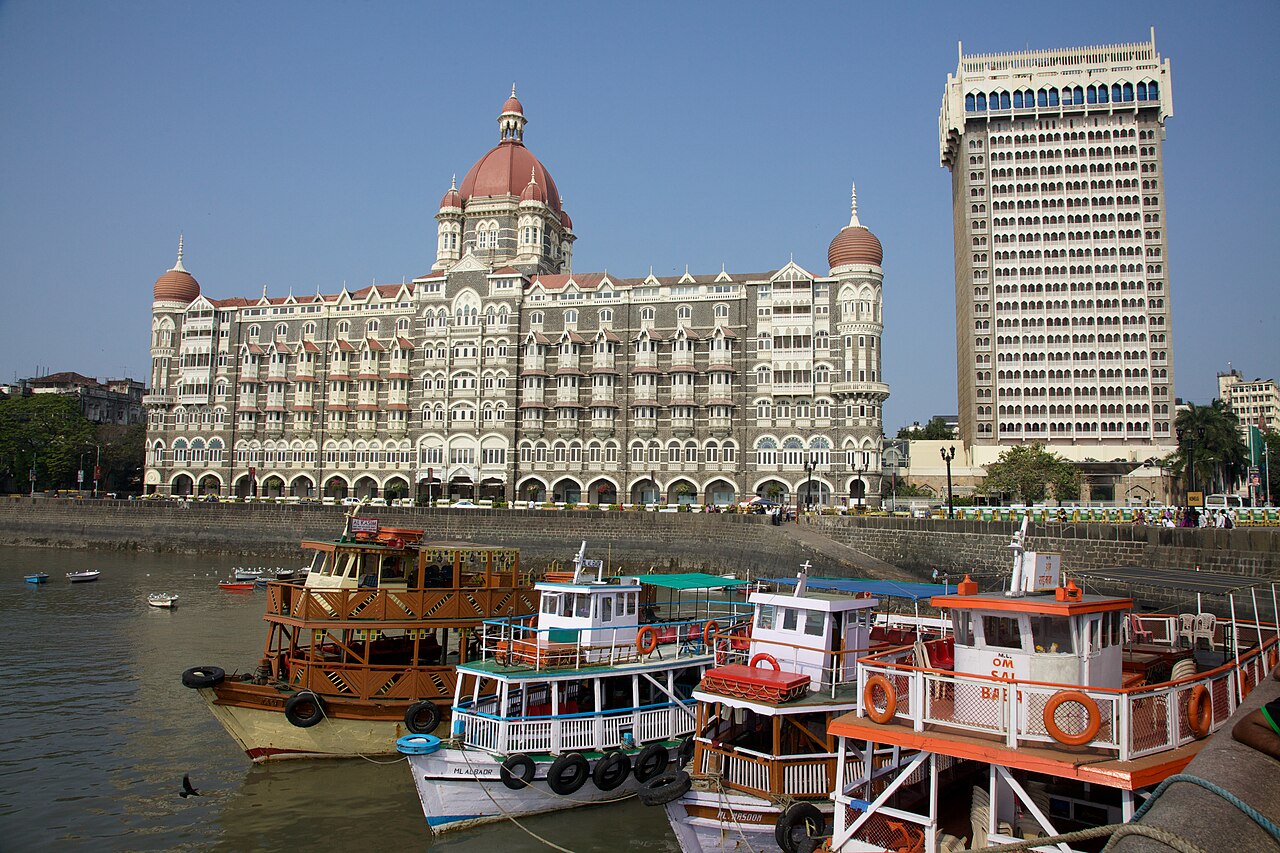
1903
An Indo-Saracenic hotel building with ornamented stonework facing the sea, standing beside a plainer high-rise tower added decades later; the two sections are historically and architecturally distinct despite forming one hotel.
Opened in 1903 as a luxury hotel, this waterfront property has long been considered among the finest in the region and is now the flagship of its hotel group. It comprises two separate structures: the original Indo-Saracenic building, and a separate tower added in 1972, historically and architecturally distinct from it. Together they hold several hundred rooms and dozens of suites. The hotel was one of the principal targets of the 2008 attacks on the city.
- It is named after a monument roughly 1,050 kilometres away, to which it has no direct connection beyond the name.
- Its two sections opened almost seventy years apart, in 1903 and 1972, and remain architecturally distinct from each other.
Photo: David Brossard (CC BY-SA 2.0)
Haji Ali Dargah
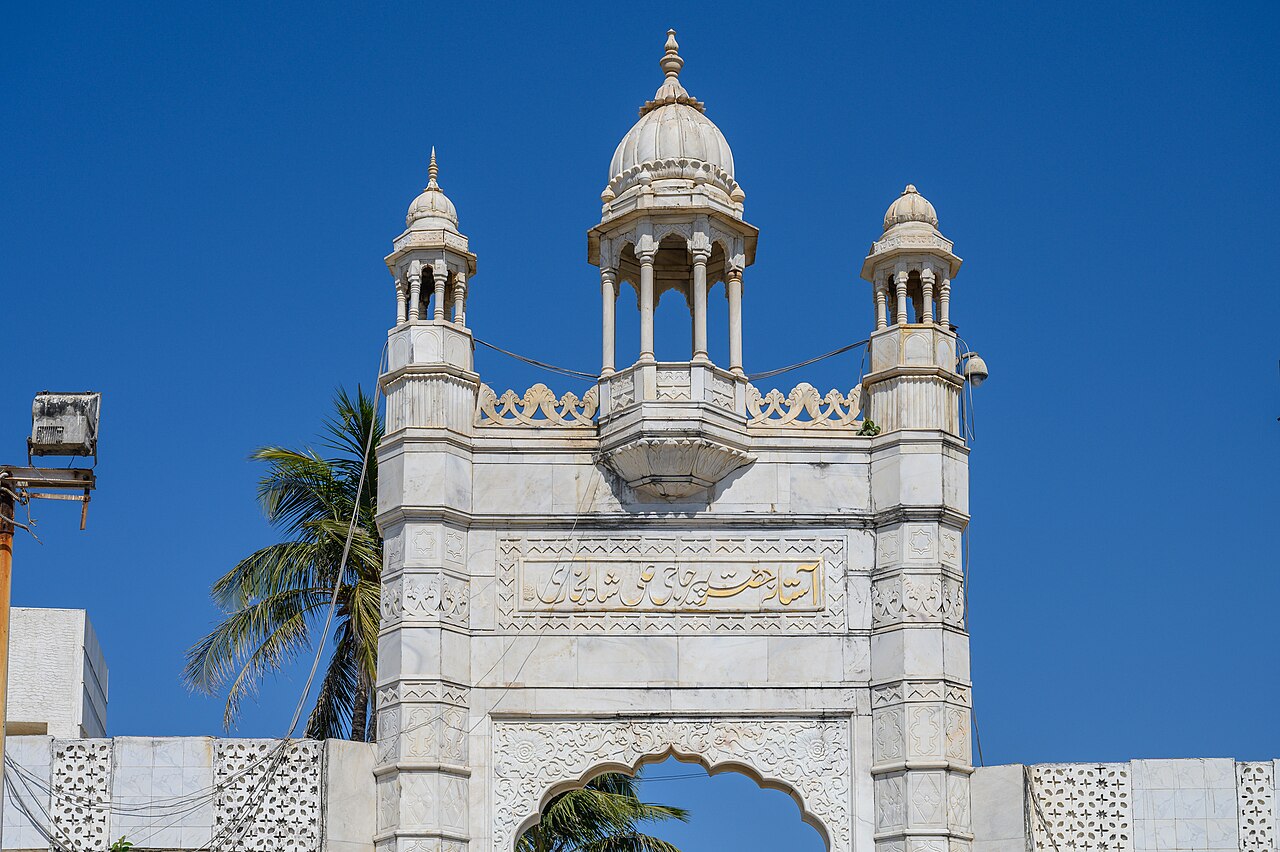
1431
A whitewashed shrine complex around a marble courtyard, its tomb draped in a red and green cloth on a silver frame beneath pillars covered in coloured-glass mirror work, standing alone on a bare rock islet linked to shore by a narrow causeway that vanishes at high tide.
This shrine on a rocky islet off Worli holds the tomb of Haji Ali Shah Bukhari, a Sufi saint and merchant from Bukhara who settled here in the fifteenth century. Built in Indo-Islamic style in 1431, the whitewashed complex encloses a marble courtyard where the tomb sits beneath a red and green cloth on a silver frame, its pillars covered in mirror work spelling the ninety-nine names of Allah. A narrow causeway links it to the mainland but floods at high tide, cutting the shrine off entirely until the water recedes.
- Renovations begun in 2008 used white marble from Makrana, Rajasthan, the same quarry that supplied marble for the Taj Mahal.
- In 2016 the Bombay High Court ruled that women could enter the inner sanctum, lifting a ban that had been in place since 2012.
Photo: xiquinhosilva (CC BY 2.0)
Siddhivinayak Temple
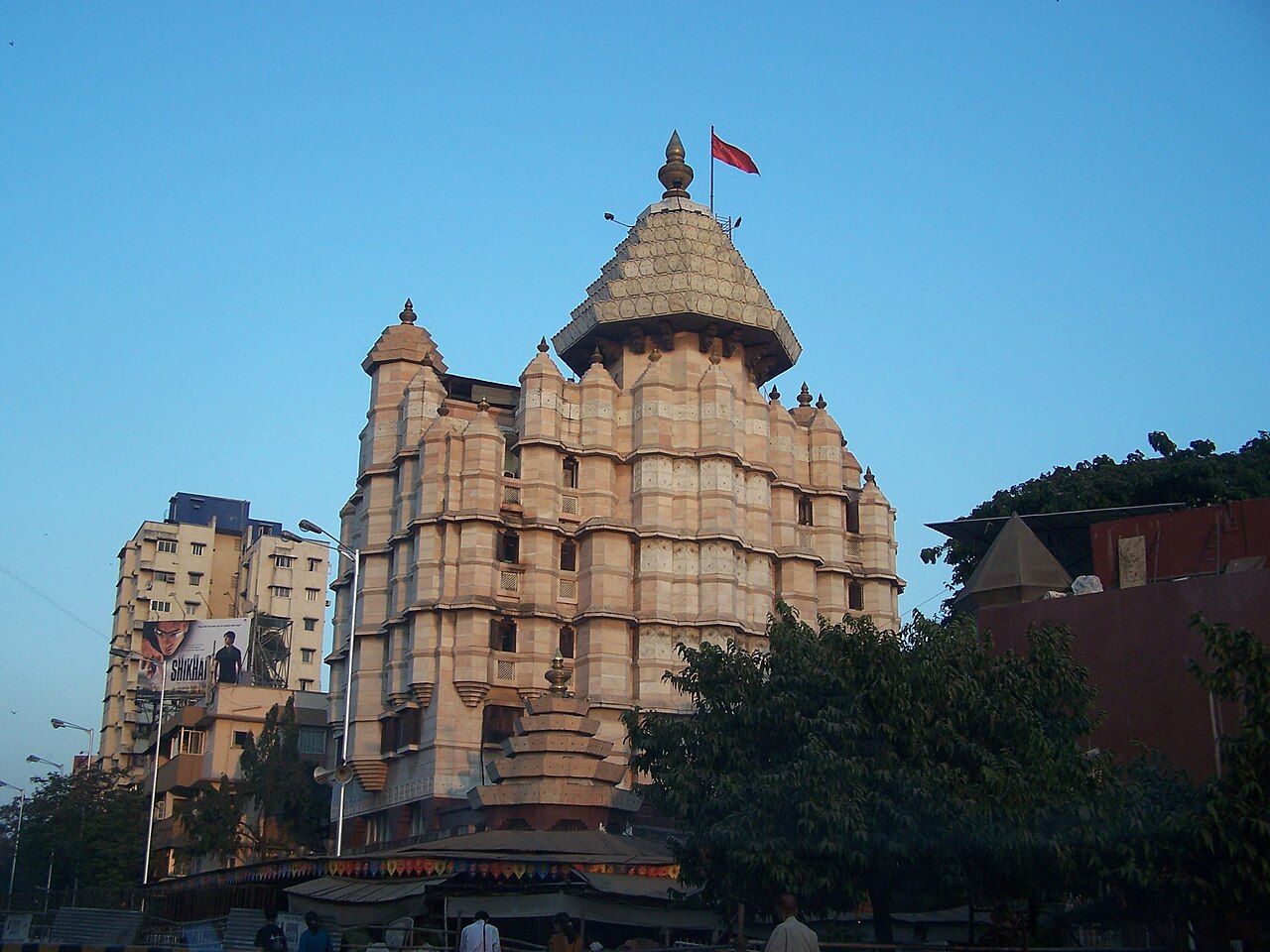
1801
A compact temple whose sanctum interior is plated in gold beneath a dome lit in changing colours each evening, its wooden doors and pillars carved with the eight regional forms of the deity it honours.
This Hindu temple dedicated to Ganesha in the Prabhadevi neighbourhood was originally built by Laxman Vithu and Deubai Patil on 19 November 1801. Its small mandap holds the sanctum, whose wooden doors and pillars are carved with the Ashtavinayaka, the eight regional forms of Ganesha, while a separate Hanuman shrine stands nearby. The sanctum's inner roof is plated in gold, and the exterior dome above it is lit in changing colours each evening. The temple is run by a trust and has become one of the wealthiest in the city.
- After the 2008 Mumbai attacks, bulletproof glass was installed around the inner sanctum housing the deity.
- The temple takes in an estimated ₹100–150 million in donations each year, making it the city's richest temple trust.
Photo: User:L1CENSET0K1LL (Public domain)
Bombay High Court
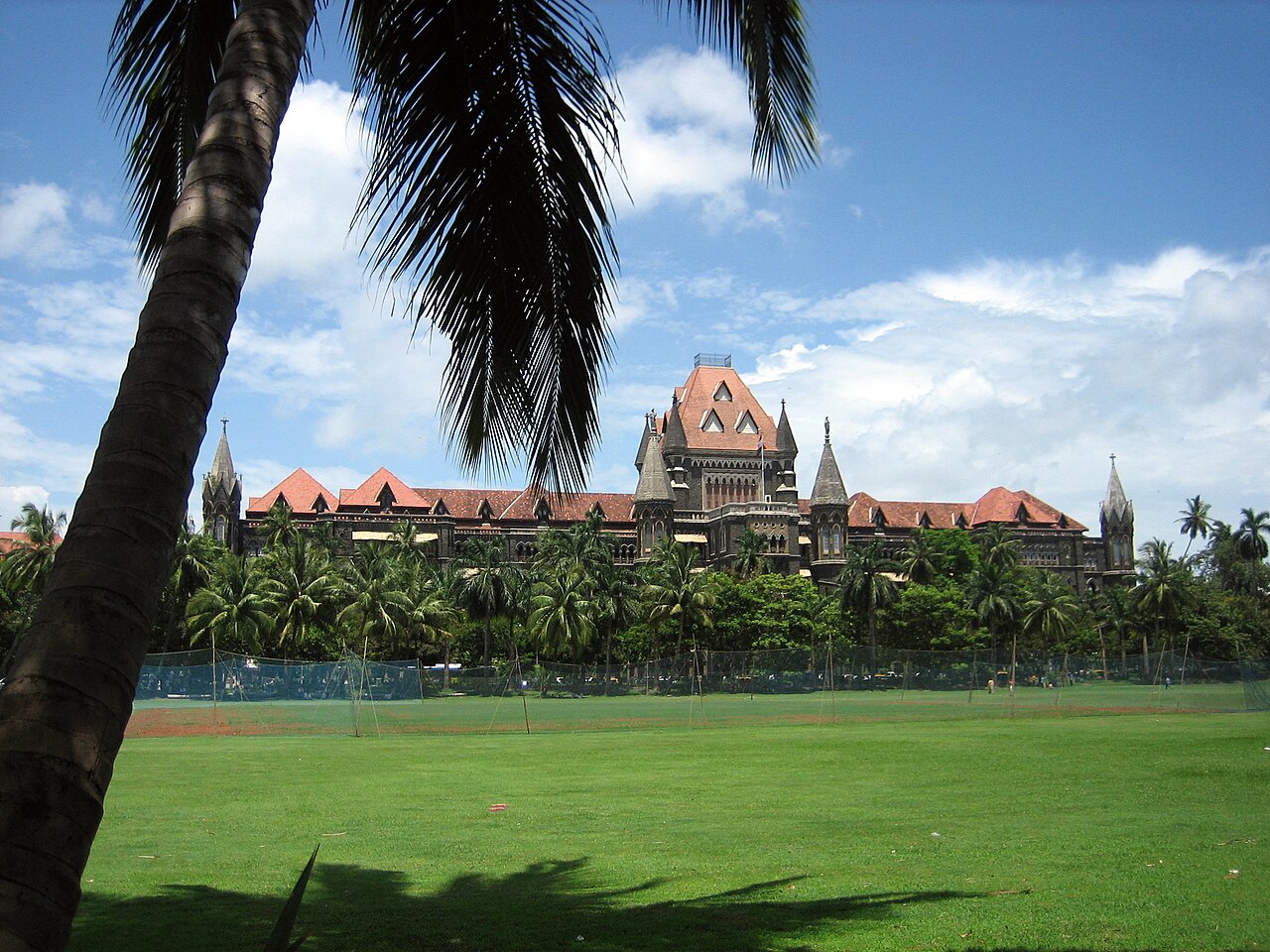
1871–1878 · James A. Fuller
A long Gothic Revival stone building, 171 metres from end to end, with two octagonal towers rising west of its central tower and statues personifying Justice and Mercy above the roofline.
This appellate court was inaugurated in 1862 under a royal charter, one of three high courts established in British India's presidency towns alongside Calcutta and Madras. Its present building, designed by engineer Colonel James A. Fuller in the Gothic Revival Early English style, was built between 1871 and 1878 and first used in January 1879. It measures 171 by 57 metres, with two octagonal towers west of its central tower and statues of Justice and Mercy above. The court retains its former city name despite a 2016 cabinet approval to rename it, still pending in parliament.
- India's first Chief Justice, Attorney General, and Solicitor General after independence all served on this court.
- Twenty-seven of its judges have since been elevated to the Supreme Court of India, and ten became Chief Justice of India.
- Though the city was officially renamed in 1995, the court kept its old name; a 2016 cabinet-approved proposal to rename it is still pending in parliament.
Photo: Michael Siegel AKA michaelj-siegel (CC BY-SA 2.0)
Marine Drive
A three-kilometre promenade on reclaimed land, built in 1940 by Pallonji Mistry along a natural bay. Its curving, banana-shaped six-lane road is nicknamed the Queen's Necklace, because its streetlights resemble a string of pearls when seen at night.
Victorian Gothic and Art Deco Ensembles of Mumbai
A UNESCO World Heritage Site since 2018, combining 19th-century Victorian Gothic public buildings with 20th-century Art Deco private ones around the Oval Maidan in the Fort precinct. The listing covers 94 buildings in total, including the Bombay High Court.
Wankhede Stadium
An international cricket stadium near Marine Drive, home ground of the Mumbai Indians and named after former BCCI president S. K. Wankhede. It hosted the 2011 World Cup final, when India became the first host nation to win the tournament, and Tendulkar's last international match.
Antilia
The private residence of billionaire Mukesh Ambani, a 27-storey, 173-metre tower built between 2006 and 2010 at a cost of nearly two billion dollars. Designed to withstand a magnitude-eight earthquake, it is one of the most expensive and largest private homes in the world.
Crawford Market
A covered market building completed in 1869, originally named for Arthur Crawford and later renamed for reformer Mahatma Jotirao Phule. In 1882 it became the first building in India lit by electricity, and it served as the city's main fruit market until 1996.
Hutatma Chowk
A square in South Mumbai centred on Flora Fountain, renamed in 1961 to honour members of the Samyukta Maharashtra Samiti killed when police fired on a demonstration in 1956. A statue titled 'Martyr with a Flame' stands beside the fountain.
St. Thomas Cathedral
The oldest church in Mumbai, with its foundation stone laid in 1676 and the building consecrated on Christmas Day 1718. It was the first Anglican church in the city and stands in Horniman Circle, named for Saint Thomas the Apostle.
National Centre for the Performing Arts
A multi-venue cultural centre founded in 1969 by J. R. D. Tata and Dr Jamshed Bhabha to promote India's performing arts. It houses the Symphony Orchestra of India, established in 2006, the first Indian orchestra to perform in Moscow, in 2010.
Raudat Tahera
The mausoleum of Syedna Taher Saifuddin and his successor, Syedna Mohammed Burhanuddin, the 51st and 52nd leaders of the Dawoodi Bohra Ismaili Muslims, in Bhendi Bazaar. Saifuddin led the community from 1915 until his death in 1965, and Burhanuddin from 1965 until 2014.
Horniman Circle Gardens
A 1.01-hectare park in the Fort district, ringed by office buildings that house leading banks. Known as Bombay Green in the 18th century and later Elphinstone Circle, it was renamed after independence in 1947 to honour Benjamin Horniman, editor of the Bombay Chronicle.
Knesset Eliyahoo Synagogue
The second oldest Sephardic synagogue in Mumbai, completed in 1884 in the Kala Ghoda area of Fort. Established by Jacob Elias Sassoon and designed by the British firm Gostling & Morris, it is known as the Blue Synagogue for its turquoise-painted facade.
Mumba Devi Temple
A Hindu temple dedicated to Mumba, the local incarnation of the goddess Parvati and patron deity of the Koli people, from whom Mumbai takes its name. Depicted as a black stone sculpture, she is still worshipped at an active pilgrimage site in the Bhuleshwar area.
Godiji
The name given to several images of the Jain Tirthankara Parshvanatha, and to the temples enshrining them, belonging to the Svetambara sect. The original image is kept at a now-empty temple in Gori, Tharparkar district, Pakistan, with another Godiji temple in Kosana village, Rajasthan.
Bombay Gymkhana
A private members' club established in 1875 at the triangular end of Azad Maidan in the Fort area, originally built as a British-only gentlemen's club and designed by architect Claude Batley. It offers members facilities for rugby, football, cricket, swimming, tennis, badminton, and squash.
Sir J. J. School of Art
The oldest art institution in Mumbai, now deemed a university. It grants bachelor's degrees in subjects including painting, ceramics, metalwork, and textile design, and master's degrees in portraiture, murals, sculpture, and printmaking.
Chor Bazaar
One of the largest flea markets in India, on Mutton Street near Bhendi Bazaar in South Mumbai. Its name means "thief" in Marathi, Gujarati, and Hindi, and popular legend holds that anything lost in the city can be bought back here.
Khada Parsi
A Grade 1 heritage monument in Byculla, installed in 1867. It features a life-sized cast iron statue of Parsi businessman and philanthropist Cursetjee Manockjee (1763-1845) atop a pillar, surrounded by mermaid fountains.
David Sassoon Library
A famous library and heritage structure in Mumbai. The idea for it came from Albert Sassoon, son of the Baghdadi Jewish philanthropist and opium-trade businessman David Sassoon.
New India Assurance Building
An Art Deco office building of reinforced concrete, built in 1937 for New India Assurance Co. Ltd., designed by Master, Sathe and Bhuta. It stands on Mahatma Gandhi Road near Flora Fountain and is cited as a key example within Mumbai's UNESCO-listed Art Deco ensembles.
Jama Mosque
A Sunni mosque in the Kalbadevi area near Crawford Market, built in stages during the 19th century in Indo-Islamic style. Mumbai's Muslim community maintains 89 mosques in total, most of them, including this one, belonging to the Sunni tradition.
Afghan Church
An Anglican church built between 1847 and 1858 to commemorate British dead of the First Afghan War and the 1842 retreat from Kabul. Designed by Henry Conybeare in Colaba, it holds some 64 historic stained-glass panels, reported in 2018 to need restoration.
Dhanraj Mahal
An Art Deco building near the Gateway of India, built between 1935 and 1938 as the city palace of Maharaja Narsingir Dhanrajgir Gyan Bahadur of Hyderabad. Clad in pale pink sandstone with curved, Parisian-inspired forms, it was reportedly Bombay's largest private residence when completed.
History
Mumbai grew out of seven separate islands once home to Marathi-speaking Koli fishing communities. Control passed from local rulers to the Portuguese Empire and then, in 1661, to the English East India Company as part of Catherine of Braganza's dowry on her marriage to Charles II. From 1782 the Hornby Vellard project reclaimed the channels between the islands from the Arabian Sea, work finished in 1845 that fused them into a single landmass and, with new roads and railways, turned the settlement into a major seaport. The buildings that still define its waterfront came slightly later: a Gothic-Indo-Saracenic railway terminus opened in 1888, a grand hotel in 1903, and the Gateway of India, completed in 1924 to mark a royal landing thirteen years earlier.